Aplomby
You get better by doing it, badly, until it stops being bad — and the hard part is doing it at all. Aplomby gives you a stage, a random topic and a clock, then scores how you did. Two minutes, no audience, no setup.
iPhone, iPad and Mac — one universal purchase.
How a rep works
The hard part of speaking practice was never the practising. It was starting. So there is nothing to set up, nothing to book, and nobody to ask.
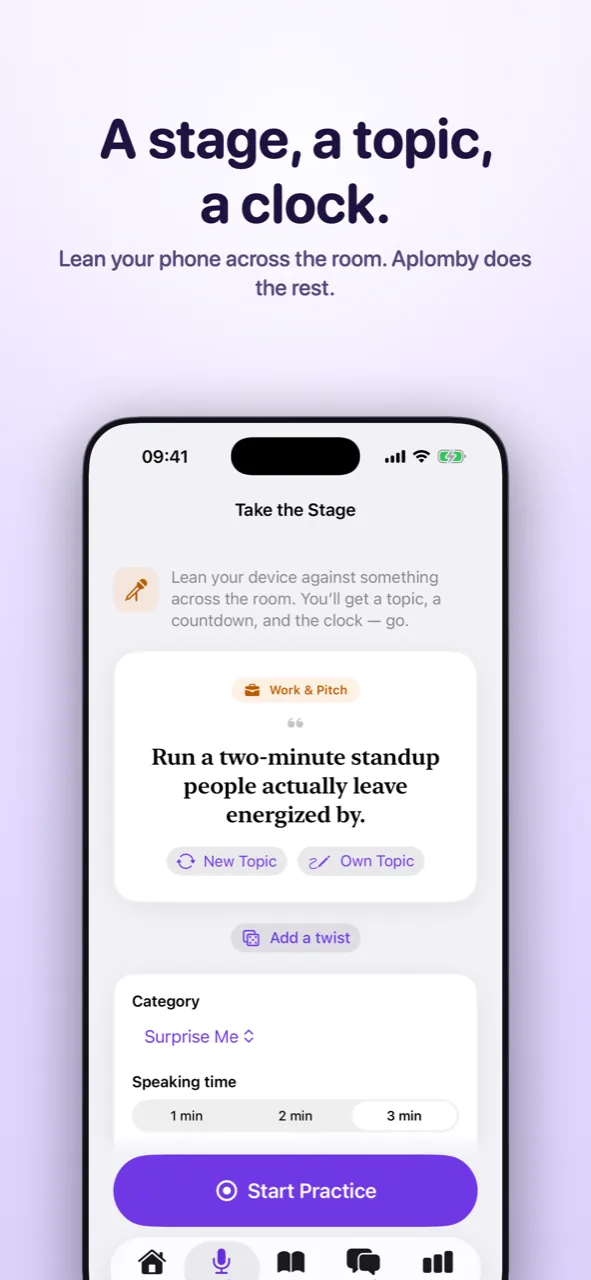
Lean it against something across the room, or just sit at your Mac. Distance is the point — the topic is set in type you can read from the far wall.
One of 100 across five categories, or bring your own if you are rehearsing something real. Then a 3–2–1 countdown, and the clock starts.
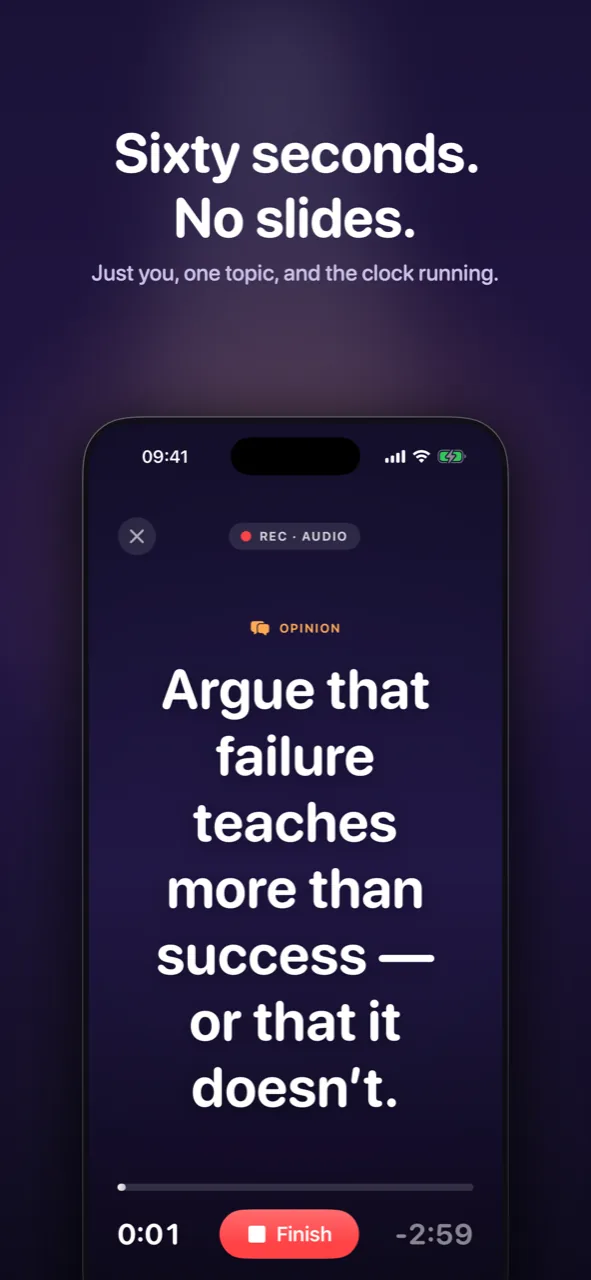
Camera and mic where they are available, audio only where they are not. Turn on curveballs and an audience question lands mid-talk with a haptic thump.
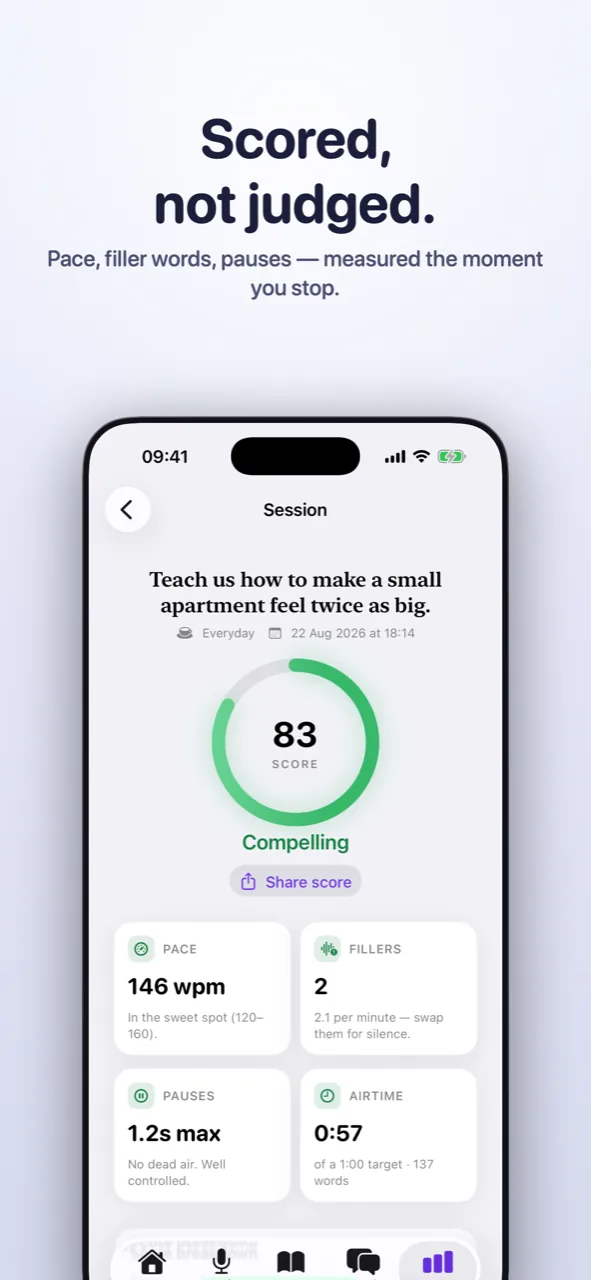
Pace, fillers, pauses and airtime, with a sub-score breakdown and any personal best it just beat. You never have to watch yourself back — though you can.
Aplomb: noun — composure under pressure. It isn’t a talent. It’s reps.
Scored, not judged
A score is not a verdict on you. It is four things about the last two minutes, each of which you can do something about before the next rep.
Words per minute, against the 120–160 range that reads as confident rather than rushed.
Every “um”, “uh” and “like”, counted and highlighted in the transcript so you can see where they cluster.
Your longest silence, in seconds. Dead air is invisible while you are in it and obvious to everyone else.
How much of the time you set aside you actually used — the gap between what you planned and what you said.
Lessons that train a measurable skill hand you straight into one of three focused drills, judged pass or fail on the score card.
Learn
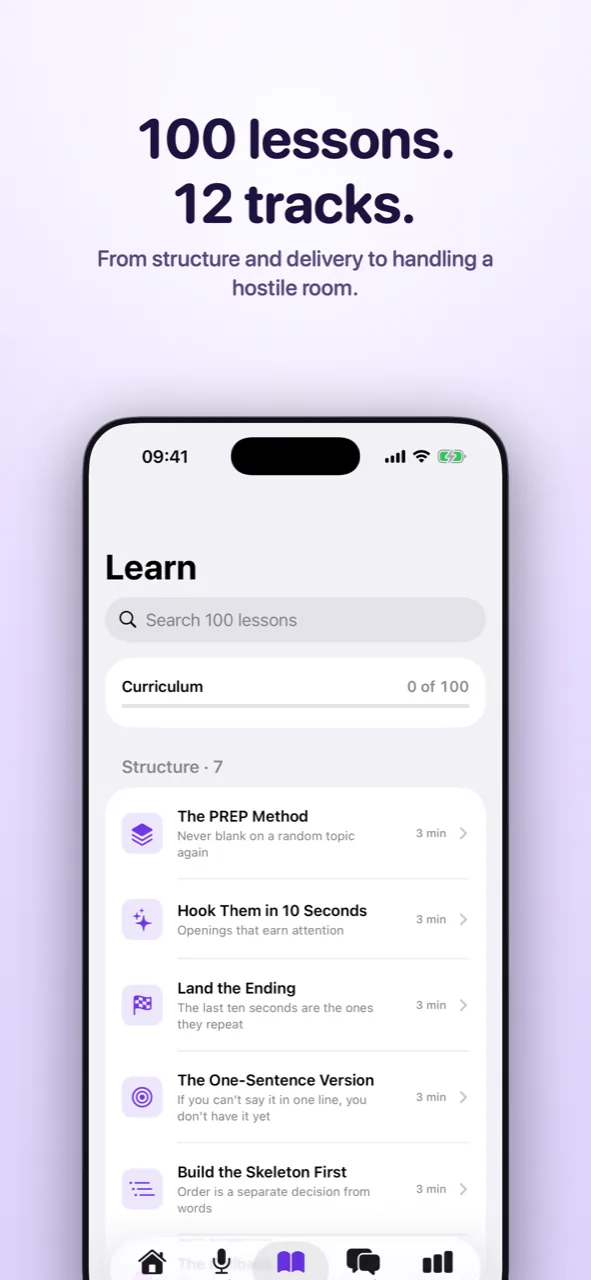
Ordered as an arc — structure first, then delivery, then the rooms you have to do it in. Each lesson is a three-minute read with one key takeaway, the mistakes people actually make, a phrase worth swapping, and a three-question quiz.
Openings, endings, and the shape that holds a talk together.
Pace, pausing, emphasis — the parts a score card can see.
Pitch, volume, warmth, and not running out of breath.
Where to put your hands, your feet and your eyes.
What the adrenaline is for, and how to spend it instead of fighting it.
Stories, examples and evidence that earn the time they take.
Making a case to people who did not arrive agreeing with you.
The hostile question, the one you cannot answer, and the save.
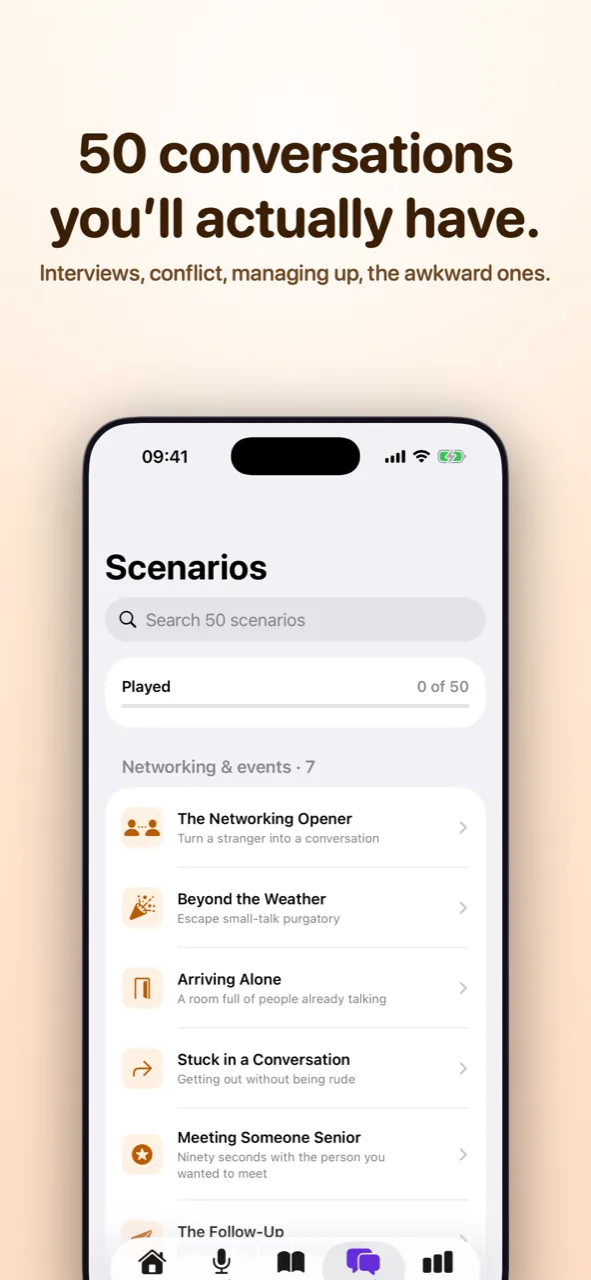
Small talk, entering a group, and leaving one without a wince.
Standups, updates, and saying the thing in the meeting.
Toasts, eulogies, introductions — the ones you cannot decline.
Cameras, panels and the particular deadness of a video call.
Scenarios
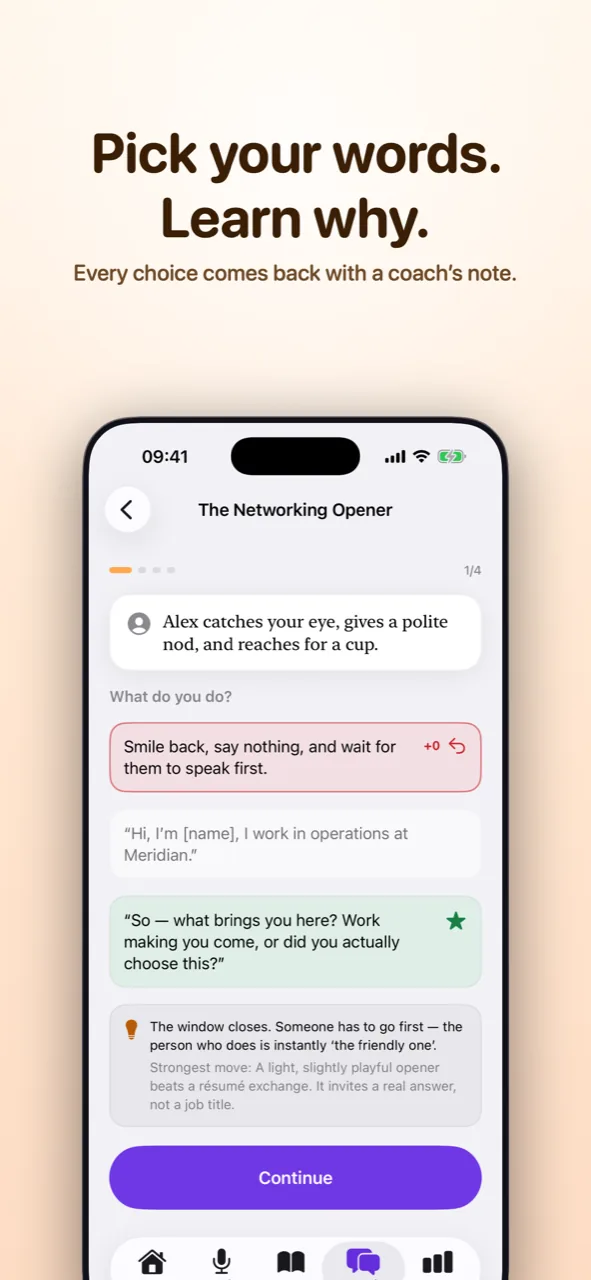
Choose-your-response dialogues drawn from real rooms — the networking opener, the hard feedback, the passive-aggressive colleague, the interview you want. Every option comes back with a coach’s note explaining why it lands or doesn’t.
The answer that does the most work in the room.
Fine. Survivable. Not the one you would replay proudly.
The instinct worth training out. The note tells you why.
Three tiers rather than right and wrong, because most real answers are neither. The finish screen recaps your run one dot per step, so the percentage always traces back to the choices that made it. And the dialogue answers you: a step written for a player who bluffed reads differently from the same step after you owned it.
Everything else
A course you finish once does nothing. What changes how you speak is turning up again, so the whole app is arranged around the next rep.
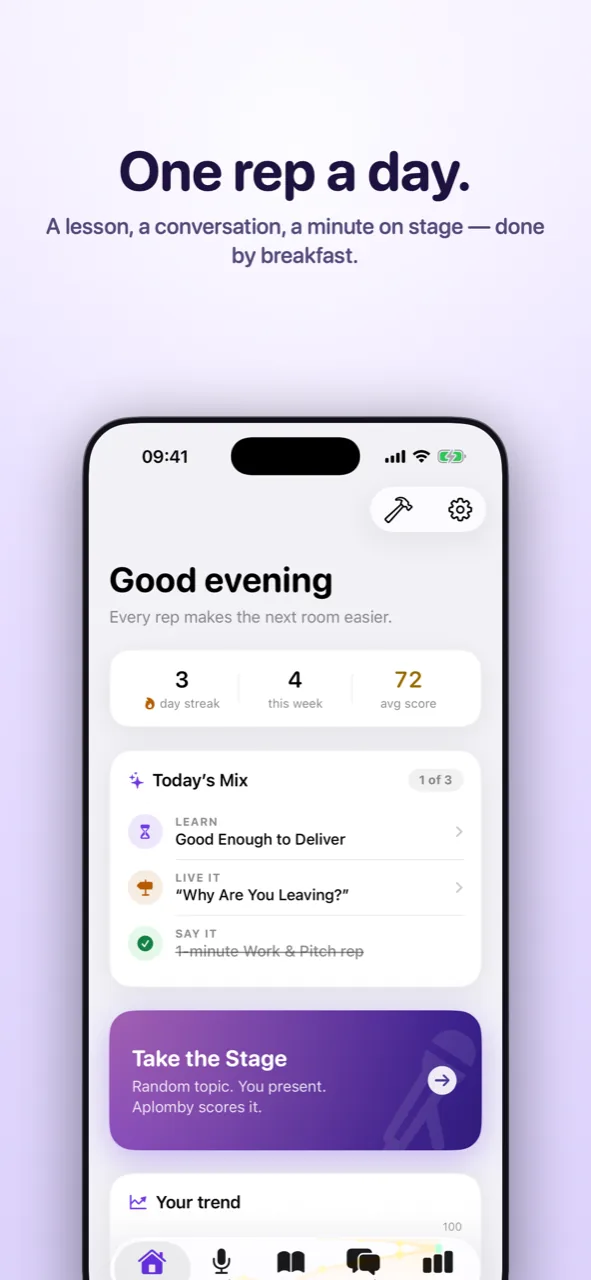
One lesson, one scenario and one stage rep a day — small enough to finish before breakfast, with per-day completion and a streak that notices.
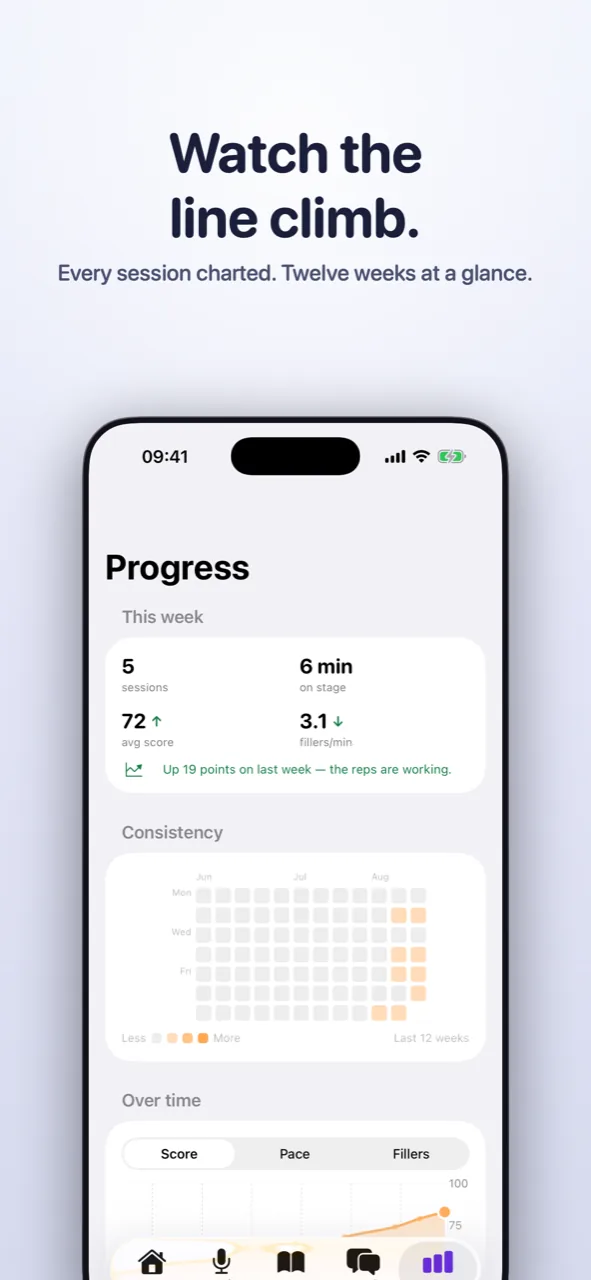
Score, pace and filler trends over time, a twelve-week consistency grid, and every session you have recorded, kept and searchable.
Streaks, zero-filler sessions, category explorer, drill mastery. All of them earned on the stage rather than handed out for opening the app.
14 surprise audience questions that drop in mid-talk, and 16 optional constraints — open with a question, make them laugh once.
One universal purchase across all three. Tabs on iOS, a sidebar on macOS, and layouts checked on every width in between.
A daily reminder, a Siri shortcut to start a practice, a recording store with a size readout and bulk delete, and CSV export of everything.
Screenshots
Take the stage
Live
Score card
Learn
Scenarios
Coach’s note
Progress
Today’s Mix
On device
Privacy
This app watches you speak. That is an unusually intimate thing to hand an app, so the answer is not a promise in a policy — it is that there is nowhere for it to go.
No account, no sign-up, no analytics, no crash reporting, no third-party SDKs of any kind. There is no server to send anything to, because there is no server.
Where a device cannot transcribe locally, Aplomby refuses to transcribe rather than let the system upload your audio. It measures your timing from the waveform instead — the rep still counts, and the score card says which two numbers are missing.
Recordings live in the app’s own container with a size readout and a bulk delete. Your history exports to CSV whenever you want it, and deleting the app takes the rest with it.
Pricing
The free tier is drawn on whole categories rather than a running count, so you can tell at a glance what you have and what you don’t.
No account, no card, no sign-up.
The yearly plan opens with a free trial. The lifetime option is a single payment.