Schwiizerdütsch · Din Wäg
Sprich wie
en Schwiizer.
Learn Schwiizerdütsch the way it is actually spoken. Climb from S Tal at 400 m to De Gipfel at 4’478 m in six stages — with real dialogues, Mundart audio you can listen to and repeat, and a stamp for every stage.
Neu in 4.0 Schwiizerli, a listening game with 60 levels


Schwiizerli · Lose-Spiil Neu in 4.0
Hear it.
Tap the Munggi.
A little more fun between lessons. A Swiss German word plays, the marmots pop up holding signs, and you tap the one with its meaning.
- Grüezi
- Znüni
- Mit em Zug
- Uf de Alp
- Dihei
- Fäscht
- Build your village. Rounds pay in Rappen for your own Swiss village, from the fountain to the 1st of August fireworks.
- Daily Mix. A round of the words that are due.
- Misses go to Chärtli. Every word you miss lands in your flashcards.

Why Grüezi?
Everything you need to learn Swiss German
Din Wäg
All 95 lessons on one path, grouped by altitude into six stages. Every lesson takes you a little higher, and the path always shows your next step.
Collect Six Stamps
Each stage ends with a 12-question Etappe-Test. Reach 80 % and its stamp is pressed into your collection, and “Das chasch jetzt” shows what you can now do. After every test you see which words to review — try again as often as you like.
Start Where You Are
Already speak Hochdeutsch or some Swiss German? A short check of up to 12 questions finds the stage that fits you. “Weiss nöd” is always an option.
Mundart Audio
Hear the word before you say it. 1’123 clips cover most of the vocabulary and the everyday phrases, spoken in Zürich dialect — with a slow replay for the sounds that need it.
20 Regions
Pick Züridütsch, Bärndütsch, Baseldütsch, Walliserdütsch and more — or start with Allgemeins Schwiizerdütsch. The app’s own words switch to your dialect group, and key words show your region’s form.
Muschter
Nine patterns that turn Hochdeutsch into Mundart, like Käse to Chäs or Rechnung to Rächnig, each with examples, exceptions and a drill: pick the word, then write it yourself.
Real-World Dialogues
30 conversations at the Bäckerei, the Bahnhof, the Beiz and beyond. Choose what to say next and get coached on it.
Spaced Repetition
Smart flashcards with the SM-2 algorithm track your mastery and schedule reviews at the optimal time.
Mini Fähler
Every word you miss comes back as a flashcard in Chärtli, due right away, so it sticks next time.
Pronunciation Practice
Record yourself speaking Swiss German — even Chuchichäschtli. Dini Ufnahm plays your take next to the original, on one time scale, and speech recognition gives you feedback.
Every Lesson Counts
A quick Wörter-Paar matching round locks in the new words, and the summary shows your XP, the words you learned and the metres you climbed. Keep your streak and earn 26 badges on the way up.
Daily Challenge
A fresh timed challenge every day — 5 questions in 60 seconds. Keep your streak alive and earn bonus XP.
Alltags-Mission
One small real-life task a week: say it at the bakery, on the tram or at a toast. Twelve missions, a new one every Monday, and a stamp for each one done.
Home Screen Widgets
On iPhone and iPad, widgets show your next stop on the path, the word of the day and your streak, so your next lesson is one tap away.
Discover
Explore Swiss cultural notes, 57 idioms, 22 dialect comparisons and immersive situation packs.
Din Wäg · 6 Etappe
From the valley to the summit
95 lessons in six stages, climbing from 400 m to 4’478 m. Pass each Etappe-Test to press its stamp into your collection.
-
Etappe 1400 m
S Tal
The Valley
Grüezi! Basics · Im Alltag
-
Etappe 2800 m
S Dorf
The Village
Getting Around · Food & Drink · Emergencies & Safety
-
Etappe 31’400 m
D Alp
The Alp
At Home · Freiziit · Nature & Mountains · Health & Body
-
Etappe 42’200 m
D Hütte
The Hut
Uf der Arbeit · Money & Banking · School & Education · Family & Generations
-
Etappe 53’000 m
De Grat
The Ridge
Kultur & Lüüt · Celebrations & Holidays · Dating & Social Life
-
Etappe 64’478 m
De Gipfel
The Summit
Fortgschritte · Tech & Modern Life
Vocabulary
23 categories to explore
Greetings
Grüezi, Hoi, Tschüss & more
Numbers
Counting the Swiss way
Food & Drink
Röschti, Fondue & beyond
Transport
Trains, trams & directions
Work
Office & professional life
Family
Relationships & home
Weather
Föhn, Schnee & seasons
Shopping
Migros, Coop & markets
Leisure
Hobbies & free time
Expressions
Swiss slang & sayings
Body
Health & body parts
Celebrations
Holidays & traditions
Culture
Swiss customs & life
Emergencies
Safety & urgent phrases
Emotions
Feelings & moods
Finance
Money & banking
Home
Around the house
Nature
Mountains, lakes & outdoors
Slang
Informal & colloquial
Social
Dating & social life
Technology
Tech & modern life
Time
Dates, times & schedules
Dialogues
30 real-world conversations
At the Restaurant
Order food, ask for the bill, and navigate Swiss dining culture.
Train Station
Buy tickets, ask for platforms, and ride the SBB like a local.
At the Doctor
Describe symptoms, understand instructions, and stay healthy.
At the Bakery
Order Gipfeli, Brötli, and talk to the Bäcker.
Meeting the Neighbors
Introduce yourself, make small talk, and settle into your new building.
Phone Call
Answer calls, leave messages, and handle phone conversations in Swiss German.
At the Office
Navigate workplace conversations, meetings, and professional Swiss German.
At the Migros
Shop at Switzerland’s iconic supermarket and handle checkout like a pro.
Screenshots
A peek inside the app

Schwiizerdütsch

Dialög

Dialäkt-Charte

Schwiizerli

Neui Wörter

Üebig

Wörter-Paar

Mini Fähler

Redewendige
Din Wäg

Muschter

Muschter üebe

Alltags-Mission

Nächschte Halt
Regions
20 regions, one Swiss German
General
Allgemeins Schwiizerdütsch
Zürich
Züridütsch
Aargau
Aargauerdütsch
Solothurn
Solothurnisch
Schaffhausen
Schaffhuserdütsch
Bern
Bärndütsch
Bernese Oberland
Bärner Oberland
Emmental
Emmentaler
Basel
Baseldütsch
Luzern
Lozärndütsch
Central Switzerland
Innerschwiiz
Glarus
Glarner
St. Gallen
Sanggallerdütsch
Rheintal
Rhiitaler
Toggenburg
Toggenburger
Appenzell
Appenzellerdütsch
Appenzell Innerrhoden
Innerhödler
Appenzell Ausserrhoden
Usserhödler
Thurgau
Thurgauerdütsch
Graubünden
Bündnerdütsch
Wallis
Walliserdütsch
The word
What does “Grüezi” mean?
Grüezi is how German-speaking Switzerland says hello — the polite, everyday greeting you hear in shops, on trains and on every hiking trail. Read more about the word.
Meaning
A polite “hello” or “good day”. It is short for Gott grüez-i — “may God greet you” — though nobody hears anything religious in it today.
Pronunciation
Roughly GRÜE-tsi, IPA [ˈɡryətsi]. The stress is on the first syllable and the ü glides into a short e — both vowels are spoken, unlike the long ü of Standard German.
When to say it
To one person you would address formally. To a group it becomes Grüezi mitenand. Around Bern you hear Grüessech instead, and friends simply say Hoi or Sali.
Our Story
Born from real experience
“Living in Switzerland without knowing Swiss German is like watching a movie with no subtitles — you catch pieces, but you miss the soul of it.”
Where it all started
KK grew up in the south of Thailand, then moved 1,250 km north for university — where even the dialect was completely different. That was her first taste of what it means to feel like a stranger.
Languages everywhere
10 months in Poland, then 4 years in Portugal for her PhD. Each country brought new barriers and the same feeling: if only there were a better way to learn.
The dialect challenge
Standard German is one thing. But Swiss German? That's a whole different world. “Chuchichäschtli,” anyone? KK realized that learning Hochdeutsch wasn't enough — to truly connect with people here, she needed Schwiizerdütsch.
Why Grüezi?
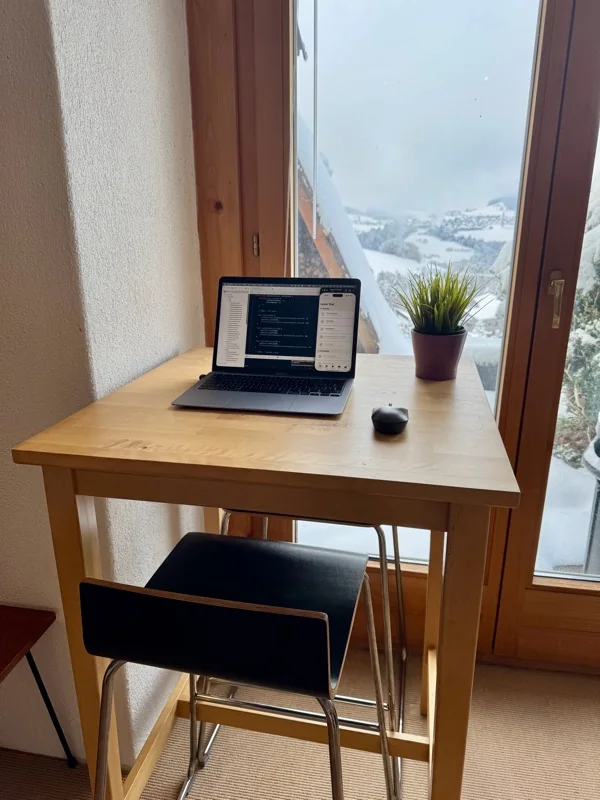
There are apps for German. But where's the app for Swiss German? The one that knows the difference between Zürideutsch and Bärndütsch? KK decided to build it herself — from her tiny 60×60 cm kitchen desk.
Grüezi was born
Built for everyone who moved to Switzerland and heard “Grüezi” for the first time and thought, “Wait, that's not German.” It's not. It's Swiss German. And now you can learn it.
From our blog
Swiss German, explained
From Käse to Chäs: 9 Patterns That Turn German into Swiss German
Kind becomes Chind, Rechnung becomes Rächnig, Zeit becomes Ziit. Nine regular patterns between Standard German and Zürich German, the exceptions that break them, and why the old vowels stayed.
Swiss German vs High German: What Actually Differs
Swiss people speak dialect and write Standard German. A plain guide to what differs between the two: everyday words, the lost past tense, no ß, and the ch.
Basic Swiss German Phrases for Everyday Life in Switzerland
Basic Swiss German phrases for daily life: at the bakery, the Migros till, on the train, at the restaurant, with neighbours, plus sorry, thank you and goodbye.
How to Say Hello in Swiss German: Grüezi, Hoi and Sali
How to say hello and goodbye in Swiss German: Grüezi or Hoi, greeting a group, Grüessech in Bern, Uf Widerluege and Tschau, and what Grüezi really means.
High German or Swiss German First? An Honest Answer
Moving to German-speaking Switzerland? Where you meet Standard German and Swiss German, what naturalisation asks for, and a sensible order to learn them.
Swiss German Words Most Germans Don’t Use (and Why)
Znüni, Rüebli, Grosi, poschte, Velo, Trottoir: everyday Swiss German words a German speaker from Germany wouldn’t use, and why so many come from French.
Zurich vs Bern German: The Big Swiss Dialects Compared
Grüezi or Grüessech, nöd or nid: how Zurich and Bern German differ in sound and words, a look at Basel and the rest, and which dialect a newcomer should learn.
Start learning Swiss German today
Free to start, no account required. On iPhone, iPad, Mac and Android.