Grüezi
From Käse to Chäs: 9 Patterns That Turn German into Swiss German
The first weeks of Swiss German can feel like learning a second vocabulary on top of German. Then something clicks. Chind is just Kind with a different first sound. Rächnig is Rechnung with a different ending. Ziit is Zeit with a long i. A surprising number of dialect words are Standard German words that went through a few regular changes.
This post walks through nine of those changes, the way Grüezi’s new Muschter (“patterns”) section teaches them: each with real examples, its exceptions and an honest note on how far it holds. Five hold for practically every native word. Four are tendencies that depend on a word’s history, and treating them as rules would teach you mistakes. The forms are Zürich German, which is what the app’s lessons are built on; other regions differ, and the sections below say where.
The nine patterns at a glance
| Pattern | Standard German | Zürich German | How far it holds |
|---|---|---|---|
| -en → -e | machen, Husten | mache, Hueschte | Rule |
| ge- → g- | gemacht, Gesundheit | gmacht, Gsundheit | Rule |
| K → Ch | Käse, Kind | Chäs, Chind | Rule |
| -ung → -ig | Rechnung, Wohnung | Rächnig, Wohnig | Rule |
| st → scht | gestern, Post | geschter, Poscht | Rule |
| -li | Schäfchen, Bächlein | Schäfli, Bächli | Often |
| eu → ü | heute, neun | hüt, nüün | Often |
| ei → ii | Zeit, Wein | Ziit, Wii | Often |
| au → uu | Bauch, Maus | Buuch, Muus | Often |
Five rules
1. -en → -e
Swiss German drops the final n. Verbs and many nouns end in -e, not -en: machen is mache, zahlen is zahle, Husten (a cough) is Hueschte, Flughafen is Flughafe. The catch is “we” and “they”: we do is mir mached, with -ed, not mache. A few words change more: morgen (tomorrow) is morn, and the short verbs gehen and sehen are gah and gseh.
2. ge- → g-
The ge- of past participles shrinks to a bare g-: gemacht is gmacht, genervt is gnärvt, gestresst is gstresst. Many nouns do the same: Gesundheit is Gsundheit, which is also what you say when someone sneezes. Before b, d, g, p, t or k the g does not simply vanish. It melts into the next sound and makes it harder, so gange (gegangen) starts with a strong g.
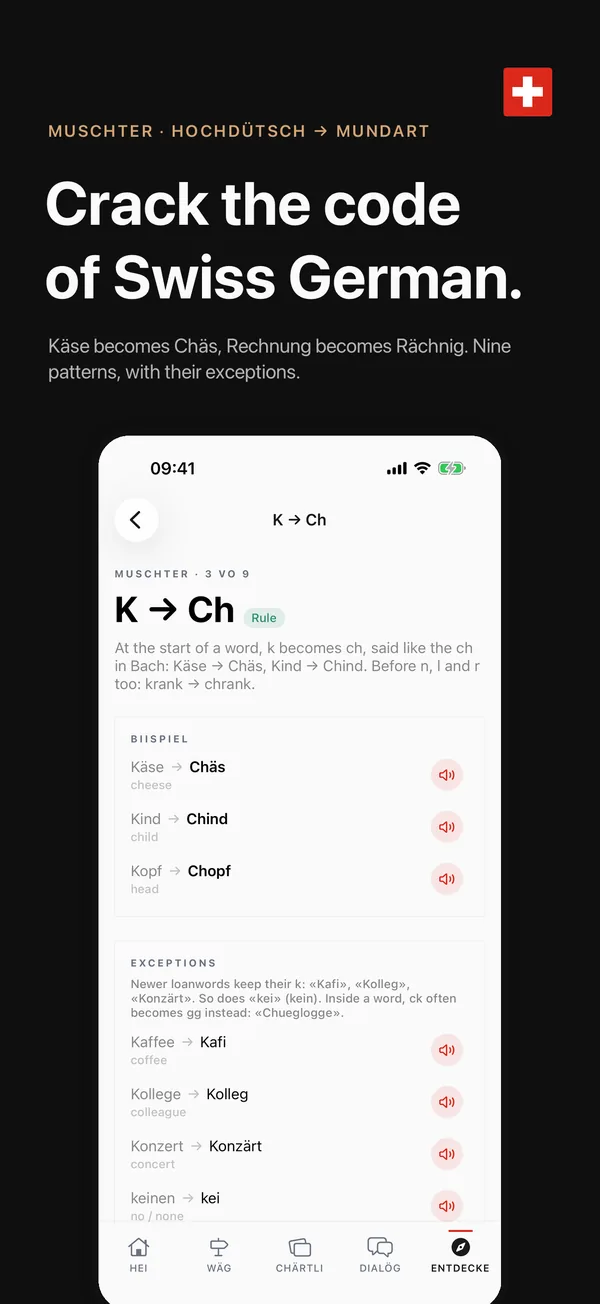
3. K → Ch
At the start of a word, k becomes ch, said at the back of the throat like the ch in Bach: Käse is Chäs, Kind is Chind, Kopf is Chopf. It works before n, l and r too (krank is chrank), and at the start of each part of a compound, so Krankenkasse, health insurance, is Chrankechasse.
Newer loanwords keep their k: Kafi (coffee), Kolleg, Konzärt. So does kei (kein). Inside a word, ck often becomes gg instead, as in Chueglogge, the cowbell. And this is a feature of most Swiss dialects, not all: traditional Basel German and the German of Chur keep the k.
4. -ung → -ig
Nouns ending in -ung end in -ig: Rechnung is Rächnig (the bill), Wohnung is Wohnig and Sitzung is Sitzig. The exception is words in -igung, which keep -ung: Entschuldigung stays as it is. And it is not universal. People from Bern city, Valais and Schaffhausen traditionally say -ung, so you will hear -ung from them in Zürich too.
5. st → scht
An s before t or p is always said sch, not only at the start of a word as in Standard German: gestern is geschter, Post is Poscht, Wurst is Wurscht and Samstag is Samschtig. Inside a word it is written sch too. At the start of a word part, the spelling usually stays st or sp, but you still say scht: umstiige (to change, on a journey), Haltstell (a bus or tram stop). Where the s and the t belong to different parts, there is no sch at all: Geburtstag.
Four tendencies
The next four are marked “often” in the app, and that label is the lesson. They hold for many words, but you cannot always predict them from the Standard German word alone.
6. -li
-li makes something small or dear: Schäfchen is Schäfli, Bächlein is Bächli, Eichhörnchen is s Eichhörnli, and a girl is a Meitli. Swiss German uses it far more than Standard German uses -chen, on almost any noun, and the word becomes neuter: es Hündli. Because it signals closeness, it belongs to relaxed speech rather than formal language.
Many -li words no longer mean small at all: Rüebli is simply a carrot, Gipfeli a croissant, Müesli just muesli. And würkli (really) and natürli (of course) end in -li only because -lich became -li.
7. eu → ü
eu and äu often become ü or üü: heute is hüt, neun is nüün, Freund is Fründ, Feuerwerk is Füürwerk, and Zürichdeutsch itself is Züridütsch. Some words keep a diphthong, written öi or eu. The one you will say most: “nice to meet you” is Fröit mi or Freut mi, never Früüt mi.
8. ei → ii
Many words with ei have a long ii: Zeit is Ziit, Wein is Wii, Freitag is Friitig and Speisekarte is Spiischarte. Not all: common words keep ei or change differently, such as eis (one), zwäi (two), Nei (no) and heiss. A useful tip if you speak English: where English has a long i, as in time or wine, Swiss German usually has ii.
9. au → uu
Many words with au have uu: Bauch is Buuch, Maus is Muus, faul (lazy) is fuul, and the Schulhaus is the Schuelhuus. The exceptions include Frau, au (auch), tauche (to dive) and gnau (exactly). The English tip works here too: where English has ou or ow, as in house or mouse, Swiss German usually has uu.
Why the old vowels stayed
The vowel patterns are not Swiss German changing German. They are Standard German changing, and Swiss German staying put. Between the 14th and 16th centuries, the long vowels of medieval German turned into diphthongs in the language that became Standard German: hūs became Haus. In everyday Swiss speech that change never took hold, and modern Swiss German, put simply, keeps the sounds of Middle High German. So the house is still a Huus, and the time is still Ziit.
That also explains the exceptions. Standard German ended up with one ei, one au and one eu for what had been two different sets of medieval sounds. Swiss German kept them apart: most words that had a long i, u or ü have ii, uu or üü, while words that already had a diphthong keep one. Nothing in today’s spelling tells you which group a word belongs to, which is why these four patterns are tendencies. Swiss German also skipped the companion change that turned old diphthongs into long vowels, which is why Kuchen is Chueche.
The ch runs the other way. Here Swiss German made a change that Standard German did not: in the Old High German sound shift, a k at the start of a word became first kch and then ch. It is the mark of the High Alemannic dialects, Zürich’s among them, which is why Basel, whose dialect is not High Alemannic, keeps its Kind.
How to use the patterns
Recognise first. The patterns pay off fastest in listening. When you hear a word you do not know, try running it backwards: turn each ch of Chrankechasse back into k, put back the n, and Krankenkasse appears. Many words carry two or three patterns at once: Stüürerklärig is Steuererklärung (eu → üü and -ung → -ig), schniide is schneiden (ei → ii and -en → -e).
Then produce, carefully. The five rules are safe to apply to everyday native words. The four tendencies are better as a way to guess and then check, because a long ii in the wrong word is the kind of mistake people notice. Learn the short exception lists by heart; they are the words you say most.
For the bigger picture of how the dialect and Standard German divide the work, read Swiss German vs High German, and for how the sounds shift from region to region, Zurich vs Bern German.
Where Grüezi comes in
New in Grüezi 3.2, Muschter sits in the Entdecke tab and teaches exactly these nine patterns. Each one has a card with its explanation in your language, its label (Rule or Often), three examples you can play in a synthesized Zürich-dialect voice, and the real words that break it. Every example on a card is a word from the app’s own vocabulary.
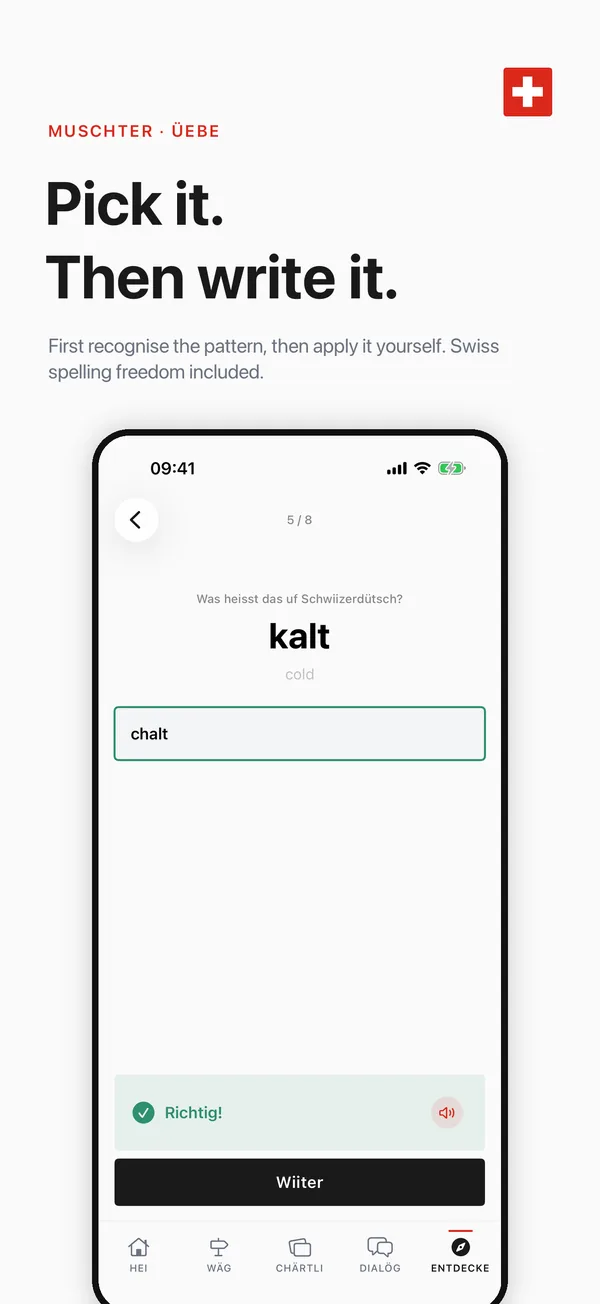
Under each card is Üebe, a short drill of up to eight words. In the first half you see a Standard German word and pick its Swiss German form from three words that all follow the same pattern, so you have to apply it rather than spot the one that looks Swiss. In the second half you type it yourself. Swiss German has no official spelling, so vowel length is yours to choose: Ziit and Zit both count, with or without an article. Ä and e are not interchangeable, so Rächnig needs its ä. The plain Standard German word is never accepted. Words you miss come back later as flashcards. And in the lessons, a word that follows a pattern gets a small chip with the pattern’s name, which opens its card.
The first two patterns, -en → -e and ge- → g-, are free, along with the first unit, Grüezi! Basics; the other seven are part of Premium. Grüezi is on iPhone, iPad and Android.

Learn the patterns behind Swiss German
The first unit and the first two Muschter patterns are free.