Tamrap
Green vs Red Curry Paste, Plus Yellow, Massaman and Panang
Green curry and red curry look like two different dishes, and on a restaurant menu they are. But open the two jars of paste side by side and they turn out to be close relatives: the same garlic, shallots, lemongrass and galangal, the same teaspoon of shrimp paste, pounded in the same order. The real difference is the chili, and whether it went into the mortar fresh or dried.
This post puts the five pastes most people meet first next to each other: green, red, yellow, massaman and panang. The amounts come from the five paste recipes in Tamrap, our Thai recipe app, so every number in the table is one a cook actually measures. After the table, each paste gets a short section of its own, and the last part is the practical question: pound your own, or buy a jar?
What all five have in common
Every one of Tamrap’s five pastes starts from the same eleven ingredients: garlic, shallots, lemongrass, galangal, makrut lime zest, cilantro roots, white peppercorns, toasted coriander and cumin seeds, shrimp paste (kapi) and salt. In all five, the galangal (1 tbsp), the lime zest (1 tsp), the cilantro roots (3), the peppercorns (1 tsp), the shrimp paste (1 tsp) and the salt (½ tsp) are exactly the same.
The method is shared too. The seeds are toasted in a dry pan and ground first, then everything is pounded in a mortar in a fixed order: “hardest (galangal, lemongrass) first, softest (garlic, chilies) last”, as the green paste recipe puts it. So when people ask what makes one curry paste different from another, the honest answer is: a handful of ingredients on top of a common base.
The five pastes side by side
These are the rows where the five recipes differ. Everything not listed is the shared base above.
| Green | Red | Yellow | Massaman | Panang | |
|---|---|---|---|---|---|
| Chilies | 10 fresh green spur 5 fresh green bird’s eye | 12 dried large red | 6 dried large red 4 yellow spur (if available) | 10 dried large red | 10 dried large red |
| Garlic | 5 cloves | 8 cloves | 6 cloves | 6 cloves | 8 cloves |
| Shallots | 3 | 5 | 4 | 5 | 5 |
| Lemongrass | 2 stalks | 2 stalks | 1 stalk | 1 stalk | 2 stalks |
| Coriander seeds | 1 tsp | 1 tsp | 1 tsp | 1 tsp | 2 tsp |
| Cumin seeds | ½ tsp | 1 tsp | 1 tsp | 1 tsp | 1 tsp |
| Added | — | — | 1 tbsp fresh turmeric | 1 cinnamon stick 3 cardamom pods 3 cloves 1 star anise ½ tsp nutmeg, grated | 3 tbsp roasted peanuts |
Read the table from the top. The first row splits the five into two families: green, made with fresh chilies, and the four others, built on dried red ones. The last row is what turns a red paste into something else: turmeric for yellow, a whole spice cupboard for massaman, peanuts for panang.
Green or red: fresh chilies or dried
This is the question most people are really asking, and the answer is short. Writing in National Geographic Traveller, Rebecca Seal calls red and green curry pastes “pretty much exactly the same”. The key difference is that red uses dried red chilies and green uses fresh green ones. Tamrap’s recipes agree almost line for line: swap the chilies, adjust the garlic and shallots, and you have moved from one to the other.
The chilies change more than the colour, though. Dried chilies are soaked first and give a deeper, earthier paste; fresh ones give a sharper, grassier one. And the Thai name of green curry has a trap in it. เขียวหวาน (khiao wan) means “sweet green”, but the same article explains that the “sweet” describes the pale colour, not the taste.
The five pastes, one by one
Green: พริกแกงเขียวหวาน
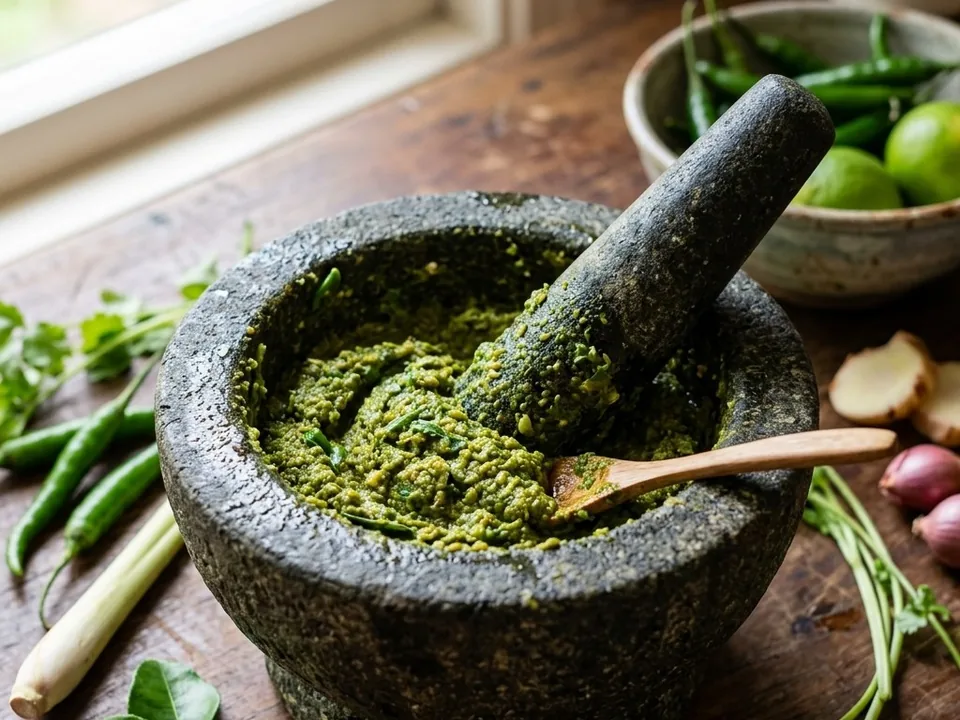
Prik gaeng khiao wan is the only one of the five made with fresh chilies: ten green spur chilies and five green bird’s eye chilies. Tamrap’s ingredient guide calls it the hottest of the classic pastes. How hot your batch turns out depends mostly on those small bird’s eye chilies; the guide’s rule for them is simple: “The smaller, the hotter.”
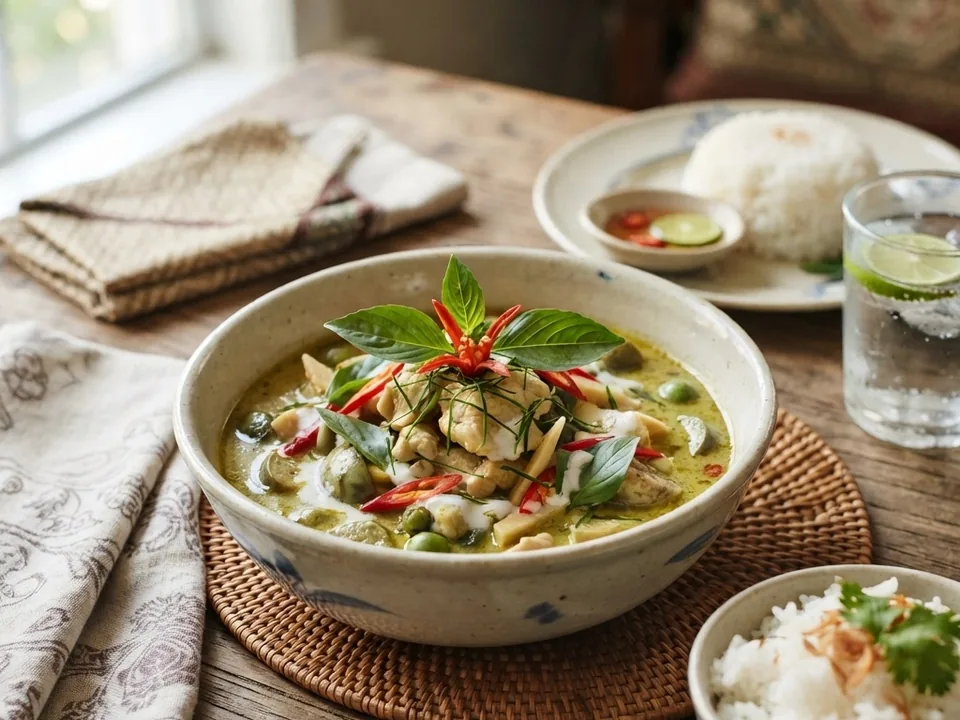
It becomes green curry, แกงเขียวหวาน: chicken thigh, Thai eggplant and bamboo shoots in coconut milk, finished with Thai basil off the heat. The recipe’s own warning is worth keeping in mind: green curry should be soupy, “not thick like panang”.
Red: พริกแกงเผ็ด
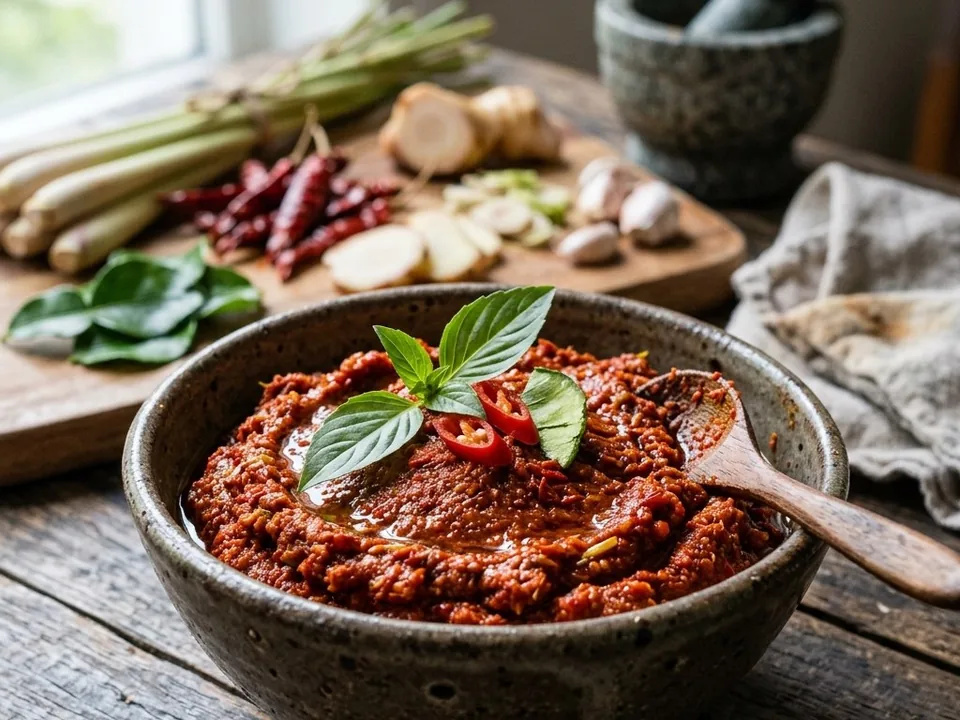
In Thai, red paste is prik gaeng phet, and the colour is not in the name. เผ็ด is the word for chili heat, the same word the cook uses when asking how much chili you want (ordering food in Thai covers that question). Tamrap’s recipe uses twelve dried large red chilies, soaked for fifteen minutes, and, with panang, the most garlic of the five. One tip from the recipe: take the white pith out of the dried chilies for “a smoother, less bitter paste”.
Red is the workhorse. In Tamrap it goes into five other recipes: the fried whole fish in curry sauce (Pla Rad Prik Gaeng), the steamed fish curry custard (Hor Mok Pla), fish cakes (Tod Mun Pla), the fish curry over rice noodles (Khanom Jeen Nam Ya) and the peanut sauce for satay.
Yellow: พริกแกงเหลือง
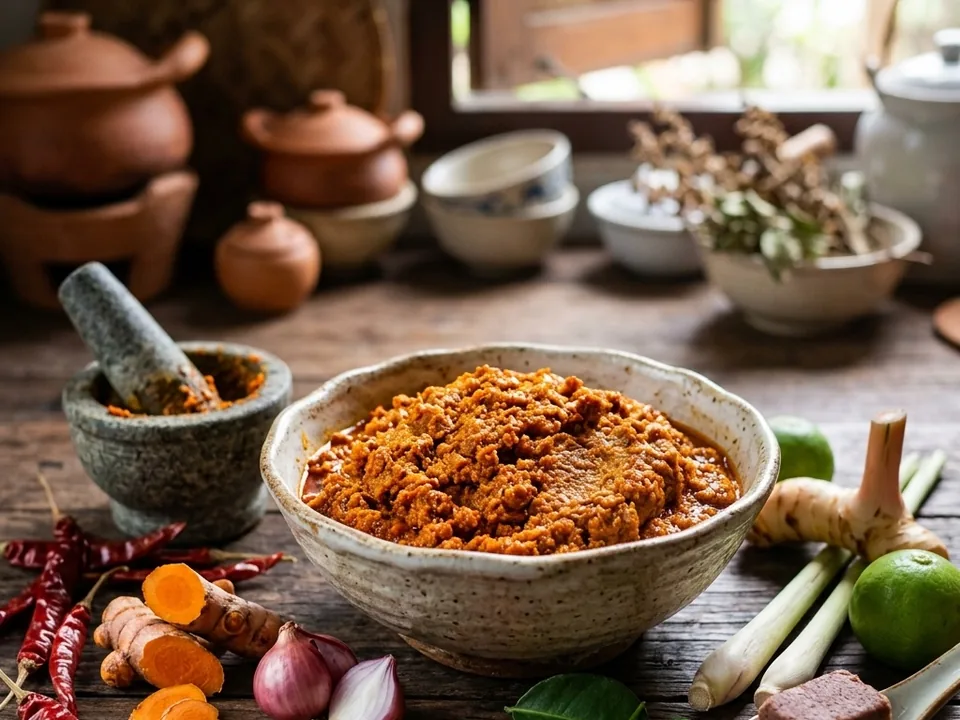
Tamrap’s yellow paste is close to its red paste, with half the dried chilies, a few yellow spur chilies if you can find them, and a tablespoon of fresh turmeric. The app files it as southern Thai, describes it as milder than red or green, and pairs it with chicken, potato and onion. It also says what yellow curry is not: “not just curry powder in coconut milk”.
One warning about the name, though. In Thailand, แกงเหลือง (gaeng-lǔeang, “yellow curry”) usually means something else: a southern fish curry, yellow with turmeric, very hot and sour. That is how Sawasdee, our Thai course, teaches the word in its unit on regional food, and the food writer Austin Bush describes the southern dish as probably the hottest curry in the country. The mild, coconut yellow curry known abroad is, in his words, a curry “of Indian origin”, and High Heel Gourmet gives its Thai name as kaeng kari. If you order “yellow curry” in Thailand, be ready for either.
Massaman: พริกแกงมัสมั่น
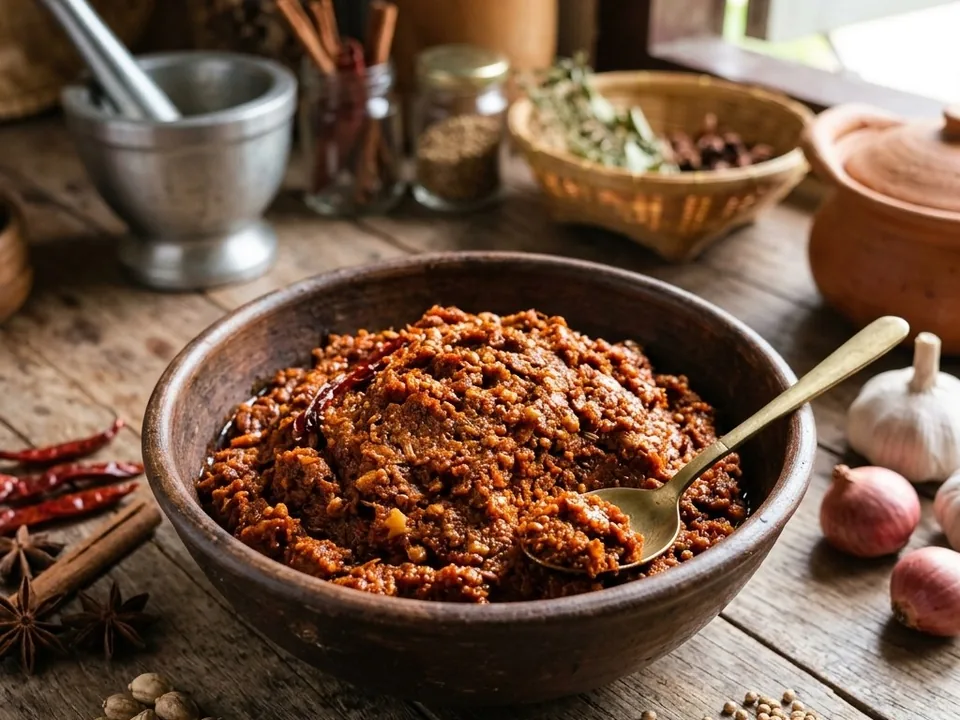
Prik gaeng matsaman uses, in the words of Tamrap’s recipe, more dried spices than any other Thai curry paste: on top of the shared base come a cinnamon stick, three cardamom pods, three cloves and a star anise, all toasted and ground, and half a teaspoon of grated nutmeg. The app’s ingredient guide calls the result the most fragrant and least fiery of the classic pastes.
The spices hint at where it came from. According to National Geographic Traveller, the word “massaman” is probably a corruption of “Mosulman”, an old word for Muslim; this style of curry is believed to have reached Siam with the first Persian envoy, and the earliest known Thai written recipe dates to 1889.
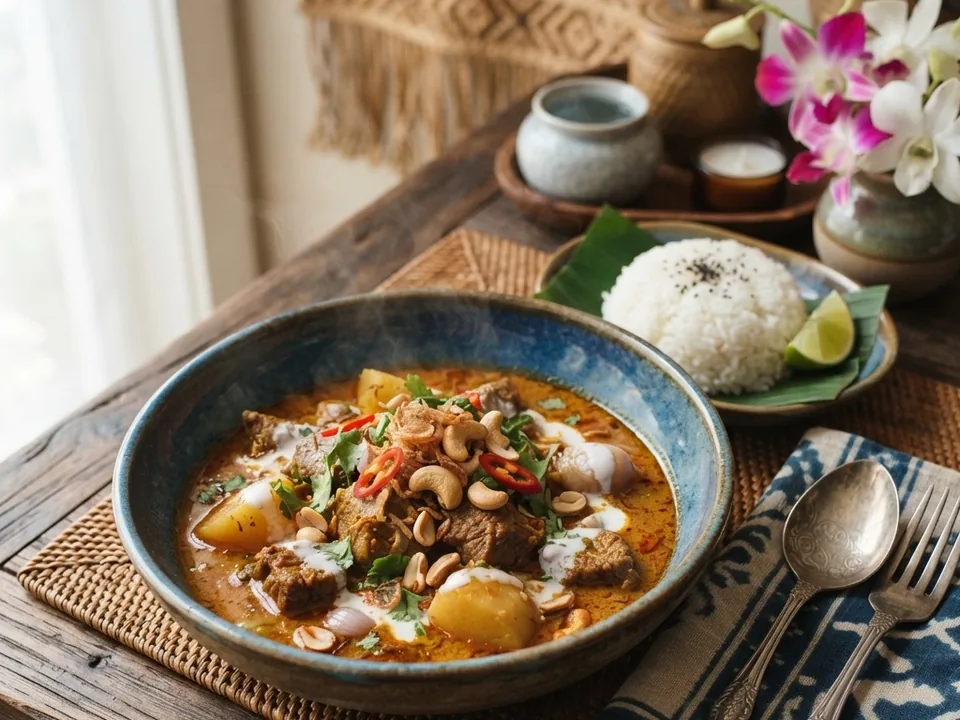
The dish is a braise. Tamrap’s massaman curry simmers beef chuck on the lowest heat for 1½ to 2 hours before the potatoes, onion, peanuts and tamarind go in for a last half hour.
Panang: พริกแกงพะแนง
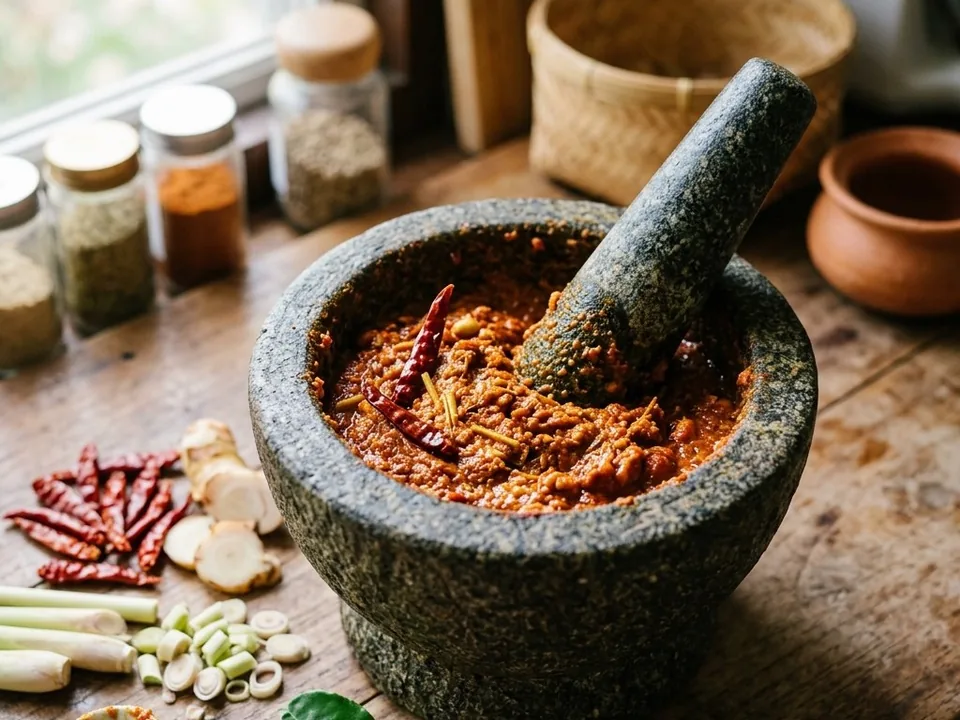
Prik gaeng phanaeng is red paste made rounder. It has three tablespoons of roasted peanuts, ground coarse and pounded in, and twice the coriander seed. It also has fewer chilies than red paste, not more: ten instead of twelve, because, as the recipe says, “the peanuts and extra coriander seed are meant to come forward”.
Panang curry is meant to be thicker and drier than green or red. Tamrap’s recipe fries the paste in coconut cream, adds thinly sliced beef, and simmers for only fifteen minutes until the sauce clings, then finishes with shredded makrut lime leaves and crushed peanuts. One of its tips sums it up: “err on the dry side, not soupy”.
Make it or buy it?
Tamrap’s paste recipes are written for a stone mortar, and they say why: a food processor “heats the ingredients and makes them bitter”. They are also honest about the effort. The red paste recipe says a mortar session “takes 30+ minutes”, and all five are marked hard. The reward is that one batch lasts: green paste keeps a week in the fridge or six months frozen, and the red recipe suggests freezing spare paste in ice-cube trays, one portion per cube.
A jar is not a failure, though. The app’s own ingredient guide calls store-bought red paste “very good”, as long as you bloom it in oil first, and suggests extra fresh chili and makrut lime leaf for a jar of green. It has stand-ins too: red paste with a spoonful of peanut butter for panang, and red paste with a pinch each of cinnamon, cardamom and cumin for massaman.
Homemade or bought, the next step is the same. Fry the paste in thick coconut cream until the oil separates. Tamrap’s green curry calls this step taek man and says it is where the curry’s aroma comes from.
Where Tamrap comes in
Tamrap is our Thai recipe app for iPhone, iPad and Android, with a step-by-step cooking mode that keeps the screen awake while you cook. All the amounts and tips in this post come from its recipes and its ingredient guide.
Fifteen of its seventy recipes are free, and the green curry recipe is one of them. The ingredient guide is free too, with entries for the green, red, massaman and panang pastes (yellow is not in it yet), their store-bought tips and stand-ins included. The five paste recipes, the massaman and panang curries and the rest of the collection come with Tamrap Pro, a one-time purchase with no subscription.

Cook Thai curry at home
15 recipes, green curry among them, and the ingredient guide are free; Tamrap Pro is a one-time purchase.