Sawasdee
Thank You and Hello in Thai: What Men and Women Say
To say hello in Thai, a man says สวัสดีครับ (sà-wàt-dee khráp) and a woman says สวัสดีค่ะ (sà-wàt-dee khâ). To say thank you in Thai, a man says ขอบคุณครับ (khòp khun khráp) and a woman says ขอบคุณค่ะ (khòp khun khâ).
| Say | Thai | Romanized |
|---|---|---|
| Hello (man) | สวัสดีครับ | sà-wàt-dee khráp |
| Hello (woman) | สวัสดีค่ะ | sà-wàt-dee khâ |
| Thank you (man) | ขอบคุณครับ | khòp khun khráp |
| Thank you (woman) | ขอบคุณค่ะ | khòp khun khâ |
Only the last word changes, and it depends on who is speaking, not on who you are speaking to. That is the one point to take with you. The rest of this post covers what the last word does, the second form a woman needs, how to pronounce it all, warmer ways to say thanks, what to answer when someone thanks you, and the wai.
Thank you in Thai for men and women: the ending follows the speaker
A man ends what he says with ครับ, a woman with ค่ะ. The listener makes no difference. If you are a man, you say ครับ to men and to women. If you are a woman, you say ค่ะ to both. The Royal Society’s Thai dictionary defines each word by who uses it: men for one, women for the other.
You can see it in a short exchange from the Sawasdee course. Tom has just held a bag of vegetables for Mali’s mother:
| Speaker | Thai | Romanized | Meaning |
|---|---|---|---|
| Mali’s mother | ขอบคุณมากค่ะ | khòp khun mâak khâ | Thank you very much. |
| Tom | ไม่เป็นไรครับ | mâi pen rai khráp | You’re welcome. |
She is thanking a man and uses her word. He is answering a woman and uses his. So a man who copies the ค่ะ he hears from a shop assistant is using her word, not his. The word for “I” works the same way: a man calls himself ผม (phǒm), a woman ฉัน (chǎn).
What ครับ and ค่ะ actually do
Neither word has a fixed English translation. Their job is politeness. A study by Amara Prasithrathsint of Chulalongkorn University notes that you can remove them and the sentence still stands, but that after hello and thank you they make the words sound less abrupt. Said on its own, either word also works as a polite answer: the study lists responding and showing agreement among their uses.
Because these words belong to a speaker, they disappear when nobody is speaking. A noodle shop’s receipt in the course ends with a bare ขอบคุณที่ใช้บริการ (khòp khun thîi chái baw-rí-gaan), “Thank you for your custom”, and written news leaves them out too. Among close friends they can drop away as well. With anyone else, keep them. As the course puts it: “When unsure, go formal. Nobody minds polite.”
ค่ะ or คะ: the two forms a woman needs
A man’s ครับ stays the same whether he is asking or answering. A woman has two forms, with different spellings and different tones. They look almost alike, and they are variants of one word, but you cannot swap them.
| Form | When | Example |
|---|---|---|
| ค่ะ | falling tone: statements and answers | ขอบคุณค่ะ khòp khun khâ Thank you. |
| คะ | high tone: questions | สบายดีไหมคะ sà-baai dee mǎi khá How are you? |
| คะ | high tone: calling someone by name | คุณทอมคะ ช่วยหน่อยได้ไหมคะ khun Tom khá chûai nàwy dâi-mǎi khá Tom, could you help me? |
| นะคะ | high tone: after นะ, which softens a sentence | ขอบคุณมากนะคะ khòp khun mâak ná khá Thank you so much. |
One line from the first unit of the course has both forms: สวัสดีค่ะ คุณทอมใช่ไหมคะ (sà-wàt-dee khâ khun Tom châi mǎi khá), “Hello. You’re Tom, right?” The greeting is a statement, so it takes ค่ะ. The question takes คะ.
After นะ the spelling is always นะคะ, and the Royal Society’s dictionary lists นะ among the words that take คะ. A man says นะครับ (ná khráp) in the same place.
How to pronounce hello and thank you in Thai
The accents in the romanization draw the pitch of your voice: no accent for mid, à for low, â for falling, á for high. If tones are new to you, Thai Tones Explained walks through all five.
| Thai | Romanized | Tones, syllable by syllable |
|---|---|---|
| สวัสดี | sà-wàt-dee | low, low, mid |
| ขอบคุณ | khòp khun | low, mid |
| ครับ | khráp | high |
| ค่ะ | khâ | falling |
| คะ | khá | high |
The kh is a k with a small puff of air after it. Spellings in Latin letters vary from one book to the next, so do not worry if you see the same words written differently.
You will often hear ครับ without its r. A University of Florida dissertation on Bangkok speech found that dropping the r from clusters like this one was the most common choice, though it still carries a stigma. Online, Thais even type the word as คับ (kháp), which the course keeps for friends, never for a boss or a form. Learn it with the r.
Thanking someone more warmly
The easiest step up is มาก (mâak), “very much”, placed before your ending. From there you can say what you are grateful for.
| Thai | Romanized | Meaning |
|---|---|---|
| ขอบคุณมากครับ | khòp khun mâak khráp | Thank you very much. (a man) |
| ขอบคุณมากค่ะ | khòp khun mâak khâ | Thank you very much. (a woman) |
| ขอบคุณมากครับ คุณใจดีมากครับ | khòp khun mâak khráp khun jai-dii mâak khráp | Thank you very much. You are very kind. |
| ขอบคุณที่ให้โอกาสครับ | khòp khun thîi hâi oo-gàat khráp | Thank you for giving me the chance. |
| ขอบพระคุณค่ะ | khàwp-phrá-khun khâ | Thank you very much. (formal, a woman) |
| ขอบพระคุณครับ | khàwp-phrá-khun khráp | Thank you very much. (formal, a man) |
ขอบพระคุณ is the formal word: in the course, Mali closes a message to her boss with it, and Tom says it to Mali’s mother. One word not to borrow is ขอบใจ (khàwp jai). The Royal Society’s dictionary marks it as used by elders to juniors, so you may hear it from an older person, but ขอบคุณ is the one for you.
And to turn down an offer politely, thank the person as you refuse: ไม่เอาครับ ขอบคุณครับ (mâi-ao khráp khòp khun khráp), “No, thank you.” You will get plenty of use from that one at the table, along with the rest of how to order food in Thai.
How to reply to thank you in Thai
ไม่เป็นไร (mâi pen rai) is the reply in the course: Tom says ไม่เป็นไรครับ and a man giving directions says the same. It is one of the most useful phrases in Thai. It also answers an apology (“No problem”) and declines an offer: ไม่เป็นไรครับ ขอบคุณครับ (mâi pen rai khráp khòp khun khráp), “No, I’m fine. Thank you.”
The other reply is ยินดีครับ or ยินดีค่ะ (yin dee khráp, yin dee khâ). In the course it means “with pleasure”, the answer when someone asks for help. An orientation Thai lesson from Prince of Songkla University teaches it as the reply to thanks and keeps ไม่เป็นไร for apologies. Either way, the ending is your own.
The wai: when to use it, and when a smile is enough
Thais also greet with the ไหว้ (wâi): palms together at the chest and a small bow of the head. It is not only for hello. The Thai Senate’s page on the wai gives it for meeting and parting, and for thanks and apology as well.
The younger or junior person does it first, and the other returns it, as Mahidol University’s Siriraj guide also explains. You do not wai a child or the staff in a shop first. If they wai you, a smile or a nod is enough, and a small wai back is fine too.
Where Sawasdee comes in
The course lines in this post come from Sawasdee, our app for learning Thai on iPhone, iPad and Android. It has 100 units in five levels. Unit 1, Greetings & Politeness, teaches ครับ, ค่ะ, the question form คะ, ไม่เป็นไร and the wai, and it is free, like the rest of the first five units. Later units are part of Premium, among them unit 30, Polite Requests, unit 72, Thai Manners, and unit 84, Formal & Informal.
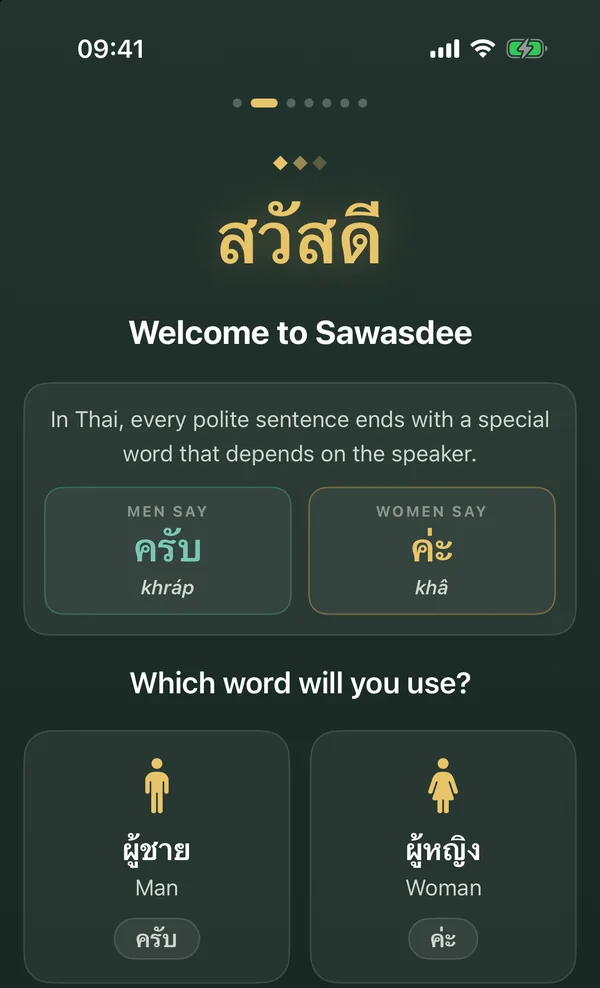
The app asks the question this post is about. During set-up it shows both words and asks “Which word will you use?”, and you can change your answer later in Settings. From then on, phrases and pattern practice show your own ending. In the dialogues each character keeps theirs, so you see Tom say ครับ and Mali say ค่ะ, and when you practise a line as yourself it switches to your ending. Tap a line to hear it. The audio is text-to-speech.

Say it right from the first lesson
The first five units are free, including Greetings & Politeness. No account required.