Grüezi
Chuchichäschtli: Meaning, Pronunciation and Why It's the Test
Chuchichäschtli means a small kitchen cupboard. It is the Swiss German for Standard German Küchenschränkchen, built from Chuchi, kitchen, and Chäschtli, little cupboard. You say it with three rough ch sounds from the back of the throat, as in Bach, and those three sounds are why it became the word Swiss people hand to outsiders as a pronunciation test.
The spelling here is the Zürich-based one from our app Grüezi. Swiss German has no official spelling, so you will see others. This post explains why this one word became the test, how to say it step by step, and what its sounds teach you about Swiss German in general.
What Chuchichäschtli means
The word comes apart cleanly:
| Swiss German | Meaning |
|---|---|
| Chuchi | kitchen (Küche) |
| Chaschte | wardrobe, closet (Schrank) |
| Chäschtli | little cupboard |
| Chuchichäschtli | kitchen cupboard |
The ending -li makes something small or dear. It also changes the vowel, so Chaschte becomes Chäschtli, and it makes the word neuter, with the article s. On its own, s Chäschtli is also the locker at the swimming pool.
So the plain translation is “kitchen cupboard”, or “little kitchen cupboard” if you want to keep the -li. You will rarely need it in a sentence, as our post on Swiss German words says. Its real job is the test.
Why this word is the famous test
A word like this is called a shibboleth: a word that shows which group a speaker belongs to. The term goes back to the Book of Judges, where a word’s pronunciation gives away fleeing enemies. Happily, the Swiss version is a game. Tell people you are learning Swiss German and, as the app warns, someone will ask you to say it.
Three things make it a good test:
The sound comes three times. The rough ch opens all three main parts of the word, so there is nowhere to hide.
It sits where Standard German has a k. Küche starts with a clean k. Swiss German has the ch there, a position where Standard German speakers are not used to it.
The third ch is a trap for German speakers. In Standard German, ch after an i is the soft sound of ich. Swiss German does not have that soft sound, so the ch after Chuchi- stays rough. English speakers have the other problem: their eye reads ch as in “church”.
The word has become a national symbol. In a 2025 interview with DIE ZEIT, Christoph Landolt, editor-in-chief of the Schweizerisches Idiotikon, the national dictionary of Swiss German, named it among the brand words that stand for the country. He added that the Swiss are less touchy about it than about Grüezi. In 2024, University of Zurich palaeontologists even gave its name to a fossil species: Ticinoteuthis chuchichaeschtli, a 242-million-year-old cephalopod that had sat in a collection cabinet for decades. We found no reliable date for when the word first became the test.
How to pronounce Chuchichäschtli
Phonetically it is [ˈχuχːiˌχæʃtli]. The main stress is on the first syllable, with a lighter stress on the third. Take it in four pieces:
| Part | How to say it |
|---|---|
| Chu | The ch of Bach, then a short u |
| chi | The same ch, held a little longer, then a short i |
| chäsch | The same ch again, ä like the a in “cat”, then sch like English sh |
| tli | A quick t and l, ending on a short i |
The ch is the hard part. Our app’s guide describes it as raspy, like gently clearing your throat, with the tongue at the back of the mouth pushing air through. It suggests starting from an ach sound and only then moving to words that begin with ch. So build up in steps:
| Step | Say | Meaning |
|---|---|---|
| 1 | Chäs | cheese |
| 2 | Chind | child |
| 3 | Chuchi | kitchen |
| 4 | Chäschtli | little cupboard |
| 5 | Chuchichäschtli | kitchen cupboard |
Go slowly at first, and let the speed come later. The slips to listen for are a k at the start, a soft ich sound in the third ch, and a plain st where the word has scht.
What its sounds teach you about Swiss German
The reason to practise this word is that you are practising three patterns found all over the language.
| Pattern | Standard German | Swiss German |
|---|---|---|
| K → Ch | Käse | Chäs |
| K → Ch | Kopf | Chopf |
| st → scht | gestern | geschter |
| st → scht | Post | Poscht |
| -li | Schäfchen | Schäfli |
| -li | Bächlein | Bächli |
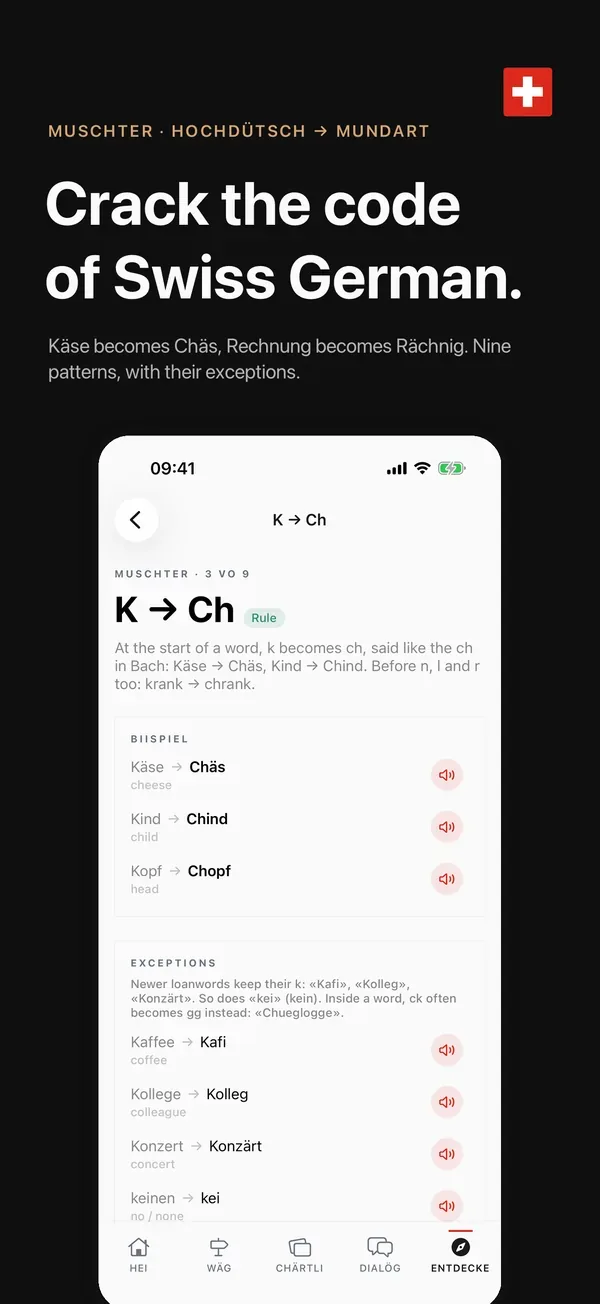
K becomes ch. This is part of the High German consonant shift, the old sound change that set High German apart from its Germanic relatives. In Swiss German it went further than in Standard German, which kept the k at the start of a word. It holds for native words, and newer loanwords keep their k: Kafi, Kolleg, Konzärt.
Basel and Chur are the exceptions. There the old k stayed, so the app gives Basel Khind for child and Kääs for cheese. We have no reliable source for how Basel says the whole word, so we give no Basel form here.
St becomes scht. An s before t is said sch, and inside a word it is written that way too. That is the sch in Chaschte and Chäschtli.
Small words end in -li. Swiss German uses it far more than Standard German uses -chen, on almost any noun. Many such words no longer mean anything small: Rüebli is simply a carrot. We go through these and others in our post on Swiss German patterns.
Once you have the word, the app has a next one for you: Chochchessel, a cooking pot, with its ch sounds even closer together.
Where Grüezi comes in
Grüezi, our app for learning Swiss German on iPhone, iPad, Mac and Android, does have this word, and its dialect is Zürich-based. Chuchichäschtli is in its vocabulary with a short clip you can tap. Like all the app’s audio, the clip is text-to-speech in one Zürich voice, not a recording of a person, so use it as a model and not as the last word. The word is taught in the lesson Tongue Twisters & Word Play, which fittingly sits in the last stage of the path, the Summit.
In the speaking practice you can record yourself and play your take straight after the clip, with both shown side by side. Trust your ear there: the score only shows that the phone’s speech recogniser understood the word, not that your ch was right.
The pronunciation guide is free and lists Chuchichäschtli with its phonetic spelling, though without audio. The first unit and the first two pattern cards are free too. The word’s clip, its lesson, speaking practice for it and the K → Ch card are part of Premium.

Work up to Chuchichäschtli
The first unit and the pronunciation guide are free. The word's clip and its lesson are part of Premium.