Willkommen
Der, Die, Das Rules: Noun Endings That Predict the Article
German gender looks random. In one small room you have der Tisch, die Tür and das Fenster, a masculine table, a feminine door and a neuter window, and nothing about the furniture explains why. For many everyday words, you simply learn the article with the noun.
But many nouns carry their gender on their sleeve. The ending gives it away, and for some endings it almost never fails. Grammar books list these endings but rarely say how far to trust them, so we checked each rule against the words our German app teaches. Here is what we found, exceptions included.
How we checked
Willkommen teaches 571 different nouns across its nine levels, from Pre-A1 to B2: 165 with der, 319 with die and 87 with das. We left out the handful of entries that are plurals, such as die Eltern (the parents), because a plural always takes die, whatever its gender. A short script then counted, for each ending, who follows the rule and who breaks it.
The headline: 210 of the 571 nouns, a little over a third, end in one of the reliable endings below, and for 209 of them the ending gives the right article.
The endings that mean die
Most of the reliable endings are feminine. Many of them turn a verb or an adjective into an abstract noun, which is why most of them arrive at B1 and B2, where the topics turn to politics, science and society.
| Ending | Nouns in the course | With die | Examples |
|---|---|---|---|
| -ung | 102 | 101 | die Wohnung, die Rechnung |
| -heit | 16 | 16 | die Freiheit, die Wahrheit |
| -keit | 18 | 18 | die Gerechtigkeit, die Öffentlichkeit |
| -schaft | 5 | 5 | die Gesellschaft, die Wissenschaft |
| -ion | 20 | 20 | die Diskussion, die Tradition |
| -tät | 8 | 8 | die Identität, die Validität |
| -ik | 7 | 7 | die Musik, die Politik |
| -ie | 13 | 13 | die Familie, die Energie |
| -enz, -anz | 10 | 10 | die Existenz, die Toleranz |
| -ei | 2 | 2 | die Bäckerei, die Partei |
| -in, for a woman | 4 | 4 | die Ärztin, die Kollegin |
The one exception in the whole table is der Aufschwung (upturn, boom), and it is an exception only on paper. Its -ung is not the noun-making ending at all: the word is built on der Schwung, one of the few masculine -ung words that grammars list by name. Where -ung is a real ending, as in die Wohnung from wohnen, it is always die. The same goes for -heit, -keit, -schaft, -ion and -tät: every one of them in the course is feminine, and the grammars agree.
-in needs a closer look. It works for women, die Ärztin, die Freundin, die Chefin, but the course also has der Termin (appointment), das Bein (leg) and das Bewusstsein (consciousness). The rule is about meaning, not spelling. -ur needs care too: six of its eight nouns are feminine, like die Natur, but not das Abitur or der Ingenieur.
-e: die, nearly nine times in ten
The commonest ending, plain -e, is less a rule than a very good bet. Of the 90 nouns in the course that end in -e, 79 take die, which is 88%. Linguists put the figure for German as a whole at about 90%, so the course is typical. The free Hamburg level has a market stall that shows the pattern well: die Banane, die Birne, die Zitrone, die Tomate, die Gurke, all feminine.
The eleven exceptions fall into groups worth knowing:
- Men. der Kollege, beside die Kollegin, and der Intellektuelle and der Ehrenamtliche (volunteer).
- The -ee words. der Kaffee, der Tee, der Schnee.
- A short list to learn by heart. das Auge (eye), das Erbe (heritage), das Gemüse (vegetables), der Name, and das Wochenende, which simply follows das Ende.
The endings that mean das
Neuter has fewer endings, but they are strong. All five -ment nouns in the course are neuter, das Argument, das Experiment, das Medikament, and so are all three in -um: das Datum, das Gymnasium, das Stipendium.
The best-known neuter endings are -chen and -lein, which make things small, and grammars treat them as always das. The course has no diminutive among its nouns; its only word in -chen is a trap, der Kuchen (cake), where the -chen is just part of the word. The famous diminutive does appear in its example sentences: Das Mädchen ist hübsch. (The girl is pretty.)
Verbs used as nouns are neuter too. Of the 15 nouns in the course ending in -en, seven take das, and six of those are verbs in disguise: das Abendessen and das Mittagessen come from essen, das Umdenken (rethinking) from denken. The seventh is das Phänomen. The other eight are masculine: der Garten, der Kuchen, der Regen.
One neuter ending is weaker than its reputation. -nis is usually listed as das, and das Ergebnis (result) and das Missverständnis follow it, but three of the five -nis nouns in the course are feminine, starting with die Erkenntnis (insight). Reference grammars put the share of feminine -nis nouns at about a third.
The endings that mean der
Masculine has the fewest reliable endings. One is -ismus: der Populismus, der Föderalismus and der Euphemismus, three of three. -or, as in der Autor, points the same way, though the course has only that one.
Here meaning helps more than spelling. All seven days of the week in the course are der, from der Montag to der Sonntag, and so are the months and seasons it teaches: der Januar, der Februar, der Sommer, der Winter.
What does not help is -er. It is masculine when it means a person who does something, but across the 30 nouns in -er in the course, 13 are masculine, 6 feminine and 11 neuter: der Vater, die Mutter, das Zimmer. Treat -er as no rule at all.
Compound nouns: the last word decides
German builds long nouns by joining short ones, and the article always belongs to the last part. The course has 31 nouns that end in another noun it teaches, and all 31 share that last noun’s article. das Zimmer gives das Schlafzimmer, das Wohnzimmer and das Badezimmer; die Freiheit gives die Meinungsfreiheit.
The first part has no say, even when it has a gender of its own. der Schlüssel (key) plus die Erkenntnis makes die Schlüsselerkenntnis, a key insight. The day may be der Sonntag, but the weekend is das Wochenende. Faced with a long word, look only at its end.
Natural gender, and das Mädchen
For people, the article usually follows the person: der Mann, die Frau, der Bruder, die Schwester. That is why die Mutter and die Schwester are feminine, whatever their ending. But a child is das Kind, and a girl is das Mädchen, because -chen makes every noun neuter, and an ending beats meaning almost every time.
In the plural, it is always die
The easiest rule of all: in the plural, every noun takes die. das Haus becomes die Häuser, der Garten becomes die Gärten, and das Zimmer becomes die Zimmer, where the article is the only thing that changes.
How to make the articles stick
The endings cover about a third of the nouns in the course. For the rest, learn the article as part of the noun. Willkommen’s grammar note puts it well: think of der Kaffee as one unit, not Kaffee alone. Say it and write it with the article, and never put a noun on a flashcard without one.
The same note suggests colour: blue for der, red for die, green for das. And let the endings do the easy work. When a new word ends in -ung or -keit, you already know its article, and you can save your memory for der Tisch, die Tür and das Fenster.
Where Willkommen comes in
Willkommen, our app for learning German on iPhone, iPad and Android, shows every noun with its article in colour: muted blue for der, red for die, green for das. A new word arrives in the Lernen step with its article large and coloured above it, and a reminder to learn the two together.
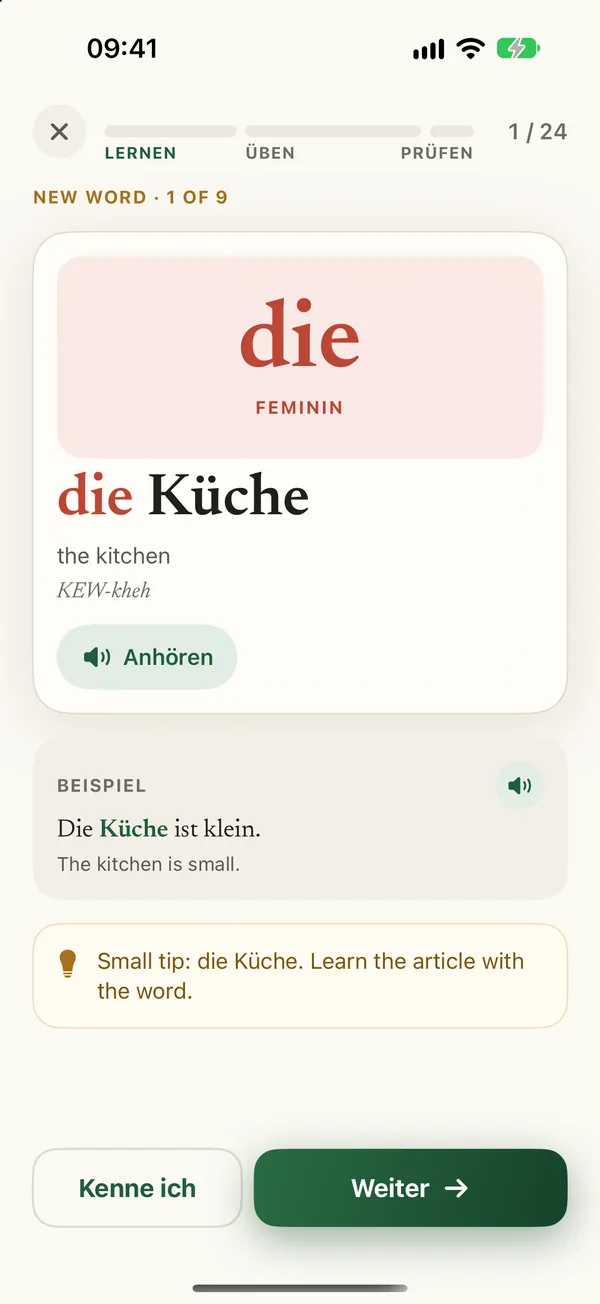
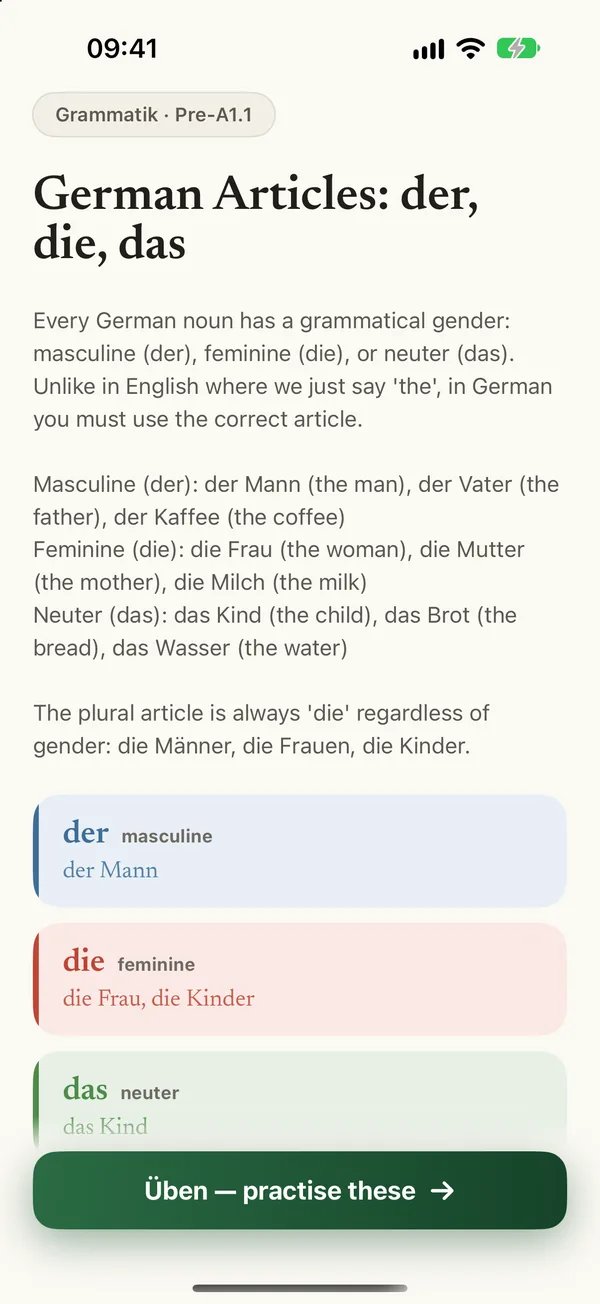
The articles have a unit of their own in Hamburg, the first city, called Der, die, das, and a grammar page that explains them, plural included. In Üben, the Der Die Das game gives you up to 20 nouns from your level, without their articles, and three buttons in the same three colours. Entdecken turns it into a picture: a classroom, a farm, a fruit stall or a park, where every object has its article, and the scenes change with each level.
Hamburg (Pre-A1) is free, with no account needed. The other eight cities, from Berlin to Basel, are part of Premium, as a monthly or yearly subscription or a one-time lifetime purchase. If verbs are the next thing on your mind, our post on German verb conjugation takes the same approach to them.

Learn every noun with its article
Hamburg, the first city (Pre-A1), is free. No account required.