Willkommen
German Verb Conjugation: Find Any Verb from the Form You Saw
You are reading something in German and meet ging. Or aß, or stand with a lonely auf a few words later, or käme. You look it up and find nothing useful, because most dictionaries file a verb under its infinitive, the form that ends in -en, and none of these look like one.
The forms are not random, though. German verbs change in a handful of patterns, and once you can see them, you can work your way back from the form on the page to the verb you need. This post walks through those patterns, turns them into a short routine for finding any verb, and ends with the irregular verbs worth learning first. Every German form here comes from the verb tables in Willkommen, our app for learning German.
Weak, strong and mixed verbs
Weak verbs are the regular ones. They keep their vowel and add endings: the past takes -te, and the past participle is ge- plus the stem plus -t. machen, to do or make, becomes machte and gemacht; kaufen, to buy, becomes kaufte and gekauft. Of the 3,227 verbs in Willkommen’s tables, 2,221 are weak.
Strong verbs change their vowel instead. gehen, to go, becomes ging and gegangen; trinken, to drink, becomes trank and getrunken. Their past has no -te, the ich and er forms have no ending at all (ich ging, er ging), and the participle ends in -en. The change cannot be guessed from the infinitive: gehen gives ging, but stehen, which looks just like it, gives stand. That is why strong verbs are learnt by heart. There are 906 of them in the tables.
Mixed verbs do a little of both: they change the vowel like a strong verb but take the -te and -t of a weak one. bringen, to bring, becomes brachte and gebracht; denken, to think, becomes dachte and gedacht. There are 73. Add a few true irregulars such as sein, haben, werden and wissen, and the modal verbs such as können and müssen, and you have every verb that does not follow the weak pattern: 1,006 in all.
The three forms that tell you everything
German grammar calls them the Stammformen, the principal parts: the infinitive, the Präteritum (simple past) and the Partizip II (past participle). The Präteritum gives you the simple past and, for strong and mixed verbs, the one-word Konjunktiv II. The participle, with haben or sein, gives you the Perfekt and the other compound tenses. For a weak verb you know all three from the infinitive. For a strong or mixed verb, the three forms are what you learn: gehen – ging – gegangen.
Which past you meet depends on where you are. Spoken German mostly tells the past in the Perfekt, with sein and haben as the big exceptions: people say ich war rather than ich bin gewesen. The Präteritum is the more formal past, and Willkommen’s course leaves it until A2.2. In Switzerland the split is sharper still: Swiss German has no simple past at all, as we explain in Swiss German vs High German.
Haben or sein in the Perfekt
Most verbs make their Perfekt with haben: hat gegessen, hat geschrieben. Verbs of movement from one place to another and of a change of state take sein: ist gegangen, ist gekommen, ist gefahren, ist aufgestanden. bleiben, to stay, and sein itself take sein too, though nothing moves. In the tables, 391 of the 3,227 verbs take sein, about one in eight, which is why it is worth learning with the verb: Gestern bin ich ins Kino gegangen, yesterday I went to the cinema.
Separable prefixes jump to the end
Many verbs are a small word glued to a base verb: auf + stehen is aufstehen, to get up; an + rufen is anrufen, to call. In a main clause in the present or the Präteritum, the prefix comes off and goes to the end: Ich stehe um sieben Uhr auf, I get up at seven o’clock. In the past that is stand … auf, and the auf can sit a long way from the stand. In the participle the ge- goes between prefix and stem: aufgestanden, angerufen, eingeladen. A full 1,342 of the verbs in the tables are separable.
Some prefixes never come off, such as be-, ver- and ent-, and their verbs take no ge- at all: verschieben, to postpone, has the participle verschoben; beweisen, to prove, has bewiesen.
The vowel change in du and er
Many strong verbs change their vowel in the present too, but only in the du and er/sie/es forms. a becomes ä: fahren – du fährst, er fährt; schlafen – er schläft; and laufen gives er läuft. e becomes i or ie: sprechen – er spricht, essen – er isst, nehmen – er nimmt, lesen – er liest. The other persons keep the plain vowel: ich fahre. So when a du or er form has an ä, an i or an ie that you cannot find, try the infinitive with a or e.
Konjunktiv II: käme, ginge, wäre
The Konjunktiv II is the “would” form, for wishes, polite requests and things that are not true. For most verbs, German simply uses würde with the infinitive: würde gehen, would go. But sein, haben, werden and the modal verbs use their own one-word forms all the time: Ich hätte gern eine Tasse Kaffee, I would like a cup of coffee.
Strong and mixed verbs have a one-word form too, and it is the one that puzzles readers. It is built on the Präteritum, with an umlaut where the vowel allows one and an -e ending: kam gives käme, ging gives ginge, aß gives äße, brachte gives brächte. So käme leads, through kam, to kommen.
From the form you saw back to the verb
Put together, the patterns give you a routine. Take off the pronoun and the ending, then ask the questions in this order:
- Is there a small word at the end of the clause? auf, an, ein, mit, zurück: it belongs in front of the verb. With stand … auf, you are looking for a verb that starts with auf.
- Is it a participle? ge- at the front, or in the middle after a prefix, and -t or -en at the end. Take the ge- out: aufgestanden is auf + gestanden. No ge- and a prefix like ver- or be-? It can still be a participle: verschoben.
- Does it end in -te? Then it is weak or mixed. Drop the -te and add -en: machte, machen. If that gives no verb, the vowel changed too, and it is one of the few mixed verbs: brachte is bringen.
- A short form with a new vowel and no -te? That is a strong Präteritum: ging, aß, kam. Here no rule gets you home; you need the list below or a lookup.
- Does it look like that, with an -e added and often an umlaut? Konjunktiv II: take them off and you are back at step 4.
- An ä, i or ie in a du or er form? Try a or e: isst, essen; fährt, fahren.
| You saw | What it is | The verb |
|---|---|---|
| ging | Präteritum, ich or er/sie/es | gehen |
| aß | Präteritum | essen |
| stand … auf | Präteritum, separable | aufstehen |
| käme | Konjunktiv II | kommen |
| brachte | Präteritum, mixed | bringen |
| isst | Präsens, du or er/sie/es | essen |
| fährt | Präsens, du or er/sie/es (fährst, fährt) | fahren |
| aufgestanden | Partizip II, with sein | aufstehen |
| verschoben | Partizip II, no ge- | verschieben |
The irregular verbs to learn first
You do not need all 1,006 at once. These are a selection of the strong, mixed and irregular verbs from the first three levels of Willkommen’s course, Pre-A1.1 to A1.2, level by level. Learn each row as one unit, and the ist in the Perfekt column with it.
| Infinitive | Meaning | er/sie/es | Präteritum | Perfekt |
|---|---|---|---|---|
| heißen | to be called | heißt | hieß | hat geheißen |
| kommen | to come | kommt | kam | ist gekommen |
| sprechen | to speak | spricht | sprach | hat gesprochen |
| sein | to be | ist | war | ist gewesen |
| haben | to have | hat | hatte | hat gehabt |
| gehen | to go | geht | ging | ist gegangen |
| aufstehen | to get up | steht auf | stand auf | ist aufgestanden |
| essen | to eat | isst | aß | hat gegessen |
| trinken | to drink | trinkt | trank | hat getrunken |
| lesen | to read | liest | las | hat gelesen |
| schreiben | to write | schreibt | schrieb | hat geschrieben |
| schlafen | to sleep | schläft | schlief | hat geschlafen |
| laufen | to run | läuft | lief | ist gelaufen |
| schwimmen | to swim | schwimmt | schwamm | ist geschwommen |
| fahren | to drive, to go by vehicle | fährt | fuhr | ist gefahren |
| nehmen | to take | nimmt | nahm | hat genommen |
| helfen | to help | hilft | half | hat geholfen |
| finden | to find | findet | fand | hat gefunden |
| bringen | to bring | bringt | brachte | hat gebracht |
Where Willkommen comes in
Willkommen, our app for learning German on iPhone, iPad and Android, added a verb section called Verben in version 3.1. It holds the 3,227 verbs counted in this post: the 180 the course teaches, each with its level, and 3,047 more. You type whatever form you saw and it finds the verb: ging finds gehen, aß finds essen, stand auf finds aufstehen, and käme finds kommen. Umlauts and ß can be typed as plain letters. The verb then opens on the rows you searched for, with its three principal parts, haben or sein, and the irregular forms marked.
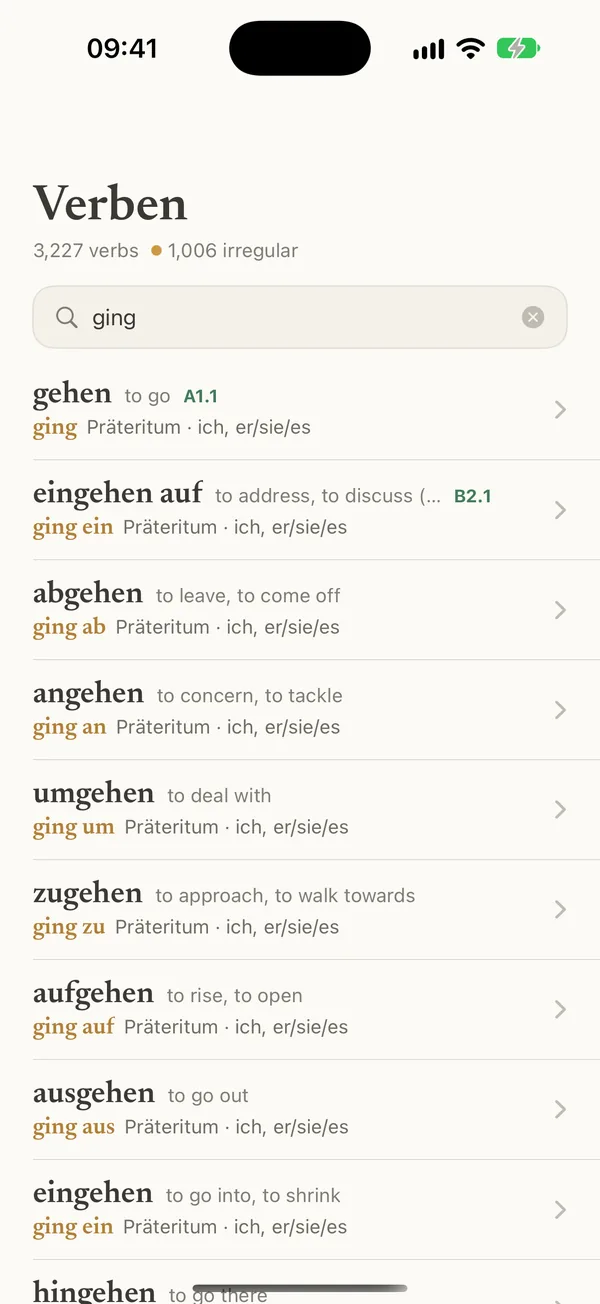
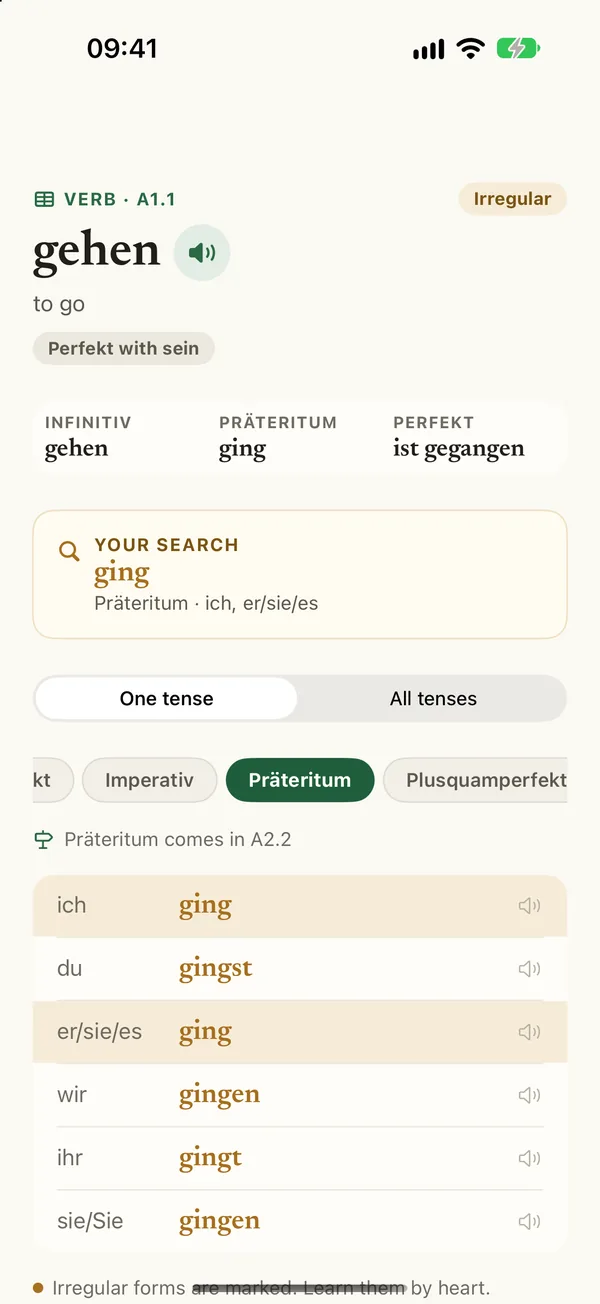
Each verb has up to eleven tables: Präsens, Präteritum, Perfekt, Plusquamperfekt, Futur I and II, the Imperativ, and four Konjunktiv tables, among them the one-word käme forms. You can see one tense at a time or all of them together, cover the forms to test yourself, and drill them in Konjugieren. Each verb can be heard said aloud, and you can look one up straight from the Heute screen.
Searching and the Präsens of every verb are free for everyone, as is Hamburg, the first city of the course. Premium adds the other tenses, the all-tenses view, cover mode and the Konjugieren drill. And if the noun next to your verb is the next puzzle, our post on der, die and das picks up from there.

Look up any German verb
Verb search and the Präsens of every verb are free, and so is Hamburg, the first city.