Tamrap
Holy Basil vs Thai Basil: How to Tell Them Apart
Holy basil and Thai basil are two different plants with two different tastes. Holy basil, กะเพรา (krapao), is peppery and tastes of clove; it is the basil in pad kaprao, the stir-fry served over rice with a fried egg. Thai basil, โหระพา (horapha), is sweet and smells of anise; it is the one you stir into green curry. Can you use Thai basil in pad kaprao? Only as a fallback: the dish comes out sweeter and milder.
That is the short answer. The rest of this post shows how to tell the two apart at the shop, which dishes take which, and how to keep them fresh. The cooking details come from the 70 recipes and the ingredient guide in Tamrap, our Thai recipe app. The botany comes from the US Department of Agriculture’s plant database and NC State University’s plant pages.
Holy basil vs Thai basil at a glance
| Holy basil | Thai basil | |
|---|---|---|
| Thai | กะเพรา krapao | โหระพา horapha |
| Plant | Ocimum tenuiflorum | Ocimum basilicum |
| Feel | Fine hairs on stems and leaves | Sturdy leaves, purple stems |
| Taste | Peppery, clove | Sweet, anise |
| Goes in | Stir-fries | Curries, at the table |
| Keeps | 2–3 days, fridge | 4–5 days, in water |
Two different plants
The confusion starts with the English names. “Thai basil” sounds like the basil of Thailand, so it is easy to assume it is the one in every Thai dish. In fact the two are separate species.
Holy basil is Ocimum tenuiflorum. The USDA’s Germplasm Resources Information Network (GRIN) lists Ocimum sanctum as another name for the same species, so you may meet either name. GRIN also gives “sacred basil” as an English name, and “tulsi”, its name in Hindi.
Thai basil is a form of ordinary basil, Ocimum basilicum, the same species as Genovese basil. NC State University’s plant database puts it plainly: Thai and Genovese basil are both cultivars of this one plant. It is often sold as Ocimum basilicum var. thyrsiflora, but GRIN does not keep that variety as a separate group and files it under plain Ocimum basilicum. So Thai basil is a close cousin of Italian basil, and holy basil is the odd one out.
How to tell them apart
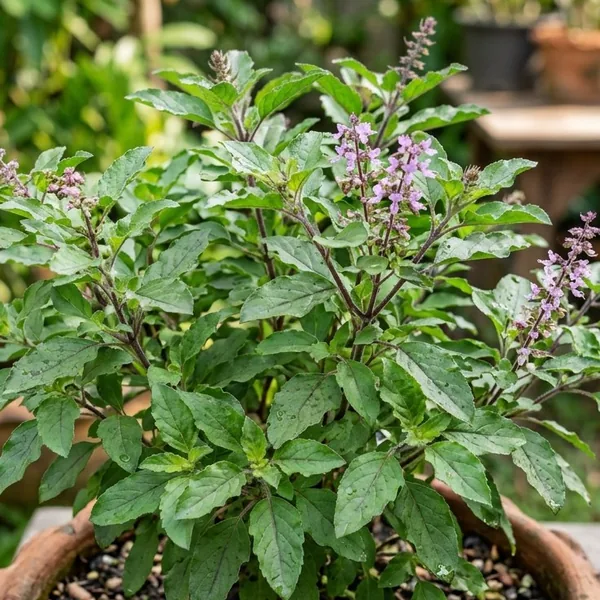
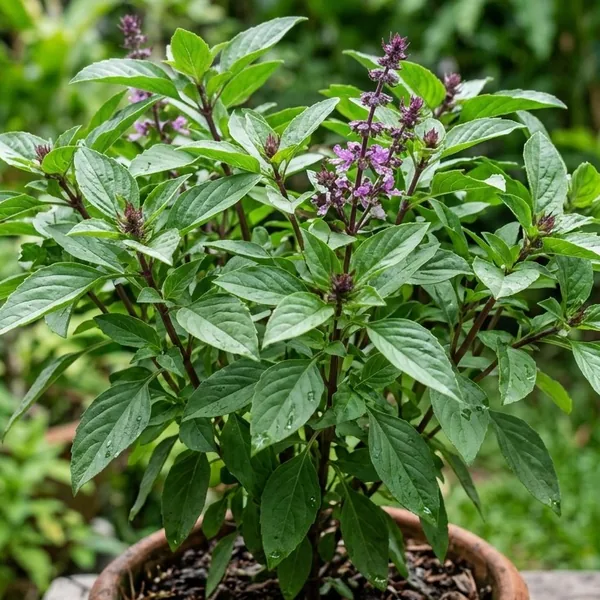
Both pictures are illustrations made for the app, so use them as a rough guide. On a real plant, three checks work better than colour alone.
Touch the stem
Holy basil is fuzzy. NC State describes its stems as “highly pubescent”, covered in fine hairs, and its leaves as hairy too, with edges that range from toothed to smooth. Tamrap’s guide describes the leaves as “slightly jagged”. Thai basil has sturdy leaves on purple stems.
Be careful with colour. Purple stems are typical of Thai basil, but NC State notes that holy basil stems can be purple or green as well. A purple stem alone does not settle it. Hairs do.
Smell a leaf
Crush a leaf between your fingers. Thai basil smells sweet, of anise and liquorice; NC State likens one Thai variety, ‘Siam Queen’, to liquorice and mint. Holy basil has none of that sweetness. NC State calls its taste “a mix of clove, mint, and basil”, and Tamrap’s guide calls it peppery and slightly sharp.
Read the Thai label
If a shop labels its herbs in Thai, กะเพรา is holy basil and โหระพา is Thai basil. The romanized names vary: holy basil is krapao in Tamrap’s guide and kaprao in its recipe title, and our Thai course in Sawasdee writes kaphrao. They are all the same word.
Which dishes use which
Tamrap’s seventy recipes draw a clear line. Holy basil appears in three, all of them stir-fries over rice:
- Pad Kaprao (ผัดกะเพรา): minced pork with garlic and chilies, two cups of holy basil, a fried egg on top.
- Pad Cha Talay (ผัดฉ่าทะเล): a fast seafood stir-fry with fingerroot, fresh green peppercorns and a handful of holy basil.
- Moo Pad Prik Sot (หมูผัดพริกสด): pork with fresh spur chilies, with holy basil as an option.
Thai basil appears in four, and none of them is a stir-fry:
- Green Curry (แกงเขียวหวาน): a cup of leaves stirred in at the end.
- Hor Mok Pla (ห่อหมกปลา): steamed fish curry custard, with the cups lined with Thai basil.
- Pla Rad Prik Gaeng (ปลาราดพริกแกง): fried whole fish in red curry sauce, Thai basil optional.
- Khua Kling (คั่วกลิ้ง): raw, on the plate of vegetables served beside this dry-fried southern minced pork.
The Hor Mok recipe shows that the leaf can do more than add scent. The basil under the custard “lifts the custard off the leaf so the base steams rather than stews”. Tamrap’s guide also suggests Thai basil on noodle soups and in drunken noodles, pad kee mao.
One habit is shared: both go in last. Pad Kaprao cooks the pork on very high heat, then says “Turn off heat. Add holy basil leaves and toss until just wilted.” The green curry tip gives the reason for Thai basil: add it “off the heat”, because “extended cooking turns the leaves black and bitter.” In both, the leaves are the last thing to go in. If you want to see how the green curry paste itself is made, our curry paste comparison sets it beside red, yellow, massaman and panang.
Can I use Thai basil in pad kaprao?
Tamrap’s Pad Kaprao recipe is firm about it: “Use holy basil (krapao), not Thai sweet basil (horapha) — they taste completely different.” Pad Cha Talay says the same, because the peppery leaf is what “cuts through the rich sauce”.
Still, holy basil is not always in the shop. The app’s guide gives the usual fallback: Thai basil with a little extra black pepper. The guide is honest about the result: the dish will be “sweeter and milder but still delicious”. It will be a good stir-fry, just not quite pad kaprao.
If you have neither Thai herb, the guide’s stand-in for Thai basil is Italian basil with a tiny pinch of ground star anise. Add it at the very end, because Italian basil wilts faster. Tamrap gives no stand-in for holy basil in a curry, so we will not invent one here.
Buying and keeping them
The two herbs want different treatment once you get them home, and here the guide is specific.
- Thai basil: stand the stems in a glass of water at room temperature, like cut flowers, and use it within four to five days. The guide warns that it blackens in the fridge.
- Holy basil: it is very perishable. Wrap it loosely and keep it in the fridge for two to three days, or stand it in water like a bouquet. The guide’s best advice is to buy it on the day you cook.
Where Tamrap comes in
Tamrap is our Thai recipe app for iPhone, iPad and Android, in ten languages. Its ingredient guide has 41 entries, holy basil and Thai basil among them, each with the Thai script, the romanized name, the taste, how to use it, what to use instead and how to store it. The guide is free. In a recipe, tap an ingredient such as “Thai basil leaves” and its guide card opens.
Fifteen of the seventy recipes are free, and two of them use these herbs: Green Curry with Thai basil, and Moo Pad Prik Sot with holy basil. Pad Kaprao, Pad Cha Talay, Hor Mok Pla and the rest of the collection come with Tamrap Pro, a one-time purchase with no subscription.

Cook with both basils
The ingredient guide and 15 recipes, green curry among them, are free; Tamrap Pro is a one-time purchase.