Michi
Katakana Chart: All 46 with English, and How to Read It
Katakana has 46 basic characters, one for every sound in hiragana, in the same order. The chart below shows all 46 with their English letters (romaji) and their hiragana partners. Japanese uses katakana mainly for words borrowed from other languages, for foreign names and for emphasis, which is why it is the script of café menus: コーヒー (koohii, coffee), ケーキ (keeki, cake).
This post is the partner to our hiragana chart, which explains how the grid, the two marks and the small letters work. Here we cover what katakana does differently: a line that stretches vowels, extra combinations for foreign sounds, and shapes that are easy to confuse.
The katakana chart: all 46 with English
Vowels run across the top and consonants down the side, exactly as in hiragana. Each cell shows the katakana, then its hiragana partner and the romaji.
| a | i | u | e | o | |
|---|---|---|---|---|---|
| – | ア あ a | イ い i | ウ う u | エ え e | オ お o |
| k | カ か ka | キ き ki | ク く ku | ケ け ke | コ こ ko |
| s | サ さ sa | シ し shi | ス す su | セ せ se | ソ そ so |
| t | タ た ta | チ ち chi | ツ つ tsu | テ て te | ト と to |
| n | ナ な na | ニ に ni | ヌ ぬ nu | ネ ね ne | ノ の no |
| h | ハ は ha | ヒ ひ hi | フ ふ fu | ヘ へ he | ホ ほ ho |
| m | マ ま ma | ミ み mi | ム む mu | メ め me | モ も mo |
| y | ヤ や ya | ユ ゆ yu | ヨ よ yo | ||
| r | ラ ら ra | リ り ri | ル る ru | レ れ re | ロ ろ ro |
| w | ワ わ wa | ヲ を o | |||
| n | ン ん n |
The romaji is Hepburn, the system Michi uses. The cells that look odd in romaji are the same ones as in hiragana: シ is shi, チ is chi, ツ is tsu and フ is fu.
The shapes themselves are simple. No basic katakana has more than four strokes, and only ネ and ホ have four. Katakana began as a shorthand built from parts of Chinese characters, and you can still see that: カ is the left side of 加. A few partners look almost the same, such as ヘ and へ, or リ and り. Most do not, so this is a second set to learn, though not a second set of sounds.
One cell rarely comes up. ヲ is read o, and the particle it could write is normally written in hiragana, as を.
Voiced sounds: 25 more, with the same two marks
The marks from the hiragana chart do the same job here, so カ becomes ガ, and ハ becomes バ or パ. That gives you パン (pan, bread), ギター (gitaa, guitar) and デパート (depaato, department store).
| a | i | u | e | o | |
|---|---|---|---|---|---|
| g | ガ ga | ギ gi | グ gu | ゲ ge | ゴ go |
| z | ザ za | ジ ji | ズ zu | ゼ ze | ゾ zo |
| d | ダ da | ヂ ji | ヅ zu | デ de | ド do |
| b | バ ba | ビ bi | ブ bu | ベ be | ボ bo |
| p | パ pa | ピ pi | プ pu | ペ pe | ポ po |
You can mostly skip ヂ and ヅ, which sound like ジ and ズ. The official list of kana for foreign words, which we come to below, leaves both of them out, along with ヲ.
Small ャ ュ ョ and ッ
These work as they do in hiragana. A small ャ, ュ or ョ merges with the character before it, as in メニュー (menyuu, menu) and シャツ (shatsu, shirt). A small ッ doubles the next consonant, as in ホット (hotto, hot drink) and サッカー (sakkaa, football). The full set is 33 combinations:
| + ya | + yu | + yo | |
|---|---|---|---|
| k | キャ kya | キュ kyu | キョ kyo |
| s | シャ sha | シュ shu | ショ sho |
| t | チャ cha | チュ chu | チョ cho |
| n | ニャ nya | ニュ nyu | ニョ nyo |
| h | ヒャ hya | ヒュ hyu | ヒョ hyo |
| m | ミャ mya | ミュ myu | ミョ myo |
| r | リャ rya | リュ ryu | リョ ryo |
| g | ギャ gya | ギュ gyu | ギョ gyo |
| j | ジャ ja | ジュ ju | ジョ jo |
| b | ビャ bya | ビュ byu | ビョ byo |
| p | ピャ pya | ピュ pyu | ピョ pyo |
The long-vowel mark: ー
This is the biggest practical difference from hiragana. Hiragana stretches a vowel by adding another kana. Katakana draws a line, ー, after any vowel: コーヒー (koohii, coffee), ジュース (juusu, juice), タクシー (takushii, taxi). Michi’s romaji doubles the vowel to show this, so ours does too.
The line can change the word. ビル (biru) is a building, and ビール (biiru) is beer. In vertical text it turns with the writing and runs down the page.
Word endings vary. English -er, -or and -ar usually become a long vowel, as in エレベーター (erebeetaa, lift), but Japan’s official spelling guidance lets writers drop the line where that is the custom. So you will meet both コンピューター and コンピュータ for “computer”, and スリッパ (surippa, slippers) has no line at all.
Combinations for foreign sounds
The basic chart has no ti, fa, she or wi. Katakana builds them by writing a small ァ, ィ, ゥ, ェ or ォ after a normal character, and the pair reads as one syllable: ファ is fa, not fu-a.
Japan’s government set these out in a 1991 Cabinet notice on writing foreign words, published by the Agency for Cultural Affairs. It has two lists. The first is for the kana generally used for foreign words and names:
| シェ she | チェ che | ジェ je | ティ ti | ディ di |
| ファ fa | フィ fi | フェ fe | フォ fo | デュ dyu |
| ツァ tsa | ツェ tse | ツォ tso |
The second is for writing a word closer to its original sound or spelling. Where that is not needed, the notice says the first list will generally do:
| ウィ wi | ウェ we | ウォ wo | イェ ye | ツィ tsi |
| ヴァ va | ヴィ vi | ヴ vu | ヴェ ve | ヴォ vo |
| クァ kwa | クィ kwi | クェ kwe | クォ kwo | グァ gwa |
| トゥ tu | ドゥ du | テュ tyu | フュ fyu | ヴュ vyu |
Here are some of them in real words:
| Kana | In a word |
|---|---|
| シェ she | シェアハウス (shea hausu, share house) |
| チェ che | チェックイン (chekkuin, check-in) |
| ティ ti | パーティー (paatii, party) |
| ファ fa | ファイル (fairu, file) |
| フィ fi | フィードバック (fiidobakku, feedback) |
| フェ fe | カフェ (kafe, café) |
| ウォ wo | ウォーキング (wookingu, walking) |
| ジェ je | ジェットエンジン (jetto enjin, jet engine) |
| ディ di | ビルディング (birudingu, building) |
| フォ fo | フォークダンス (fooku dansu, folk dance) |
| ウィ wi | ウィスキー (wisukii, whisky) |
| ヴァ va | ヴァイオリン (vaiorin, violin) |
Spelling is not fixed in the second list. The notice itself gives both ヴァイオリン and バイオリン for violin, and both ウィスキー and ウイスキー for whisky. It also notes that custom leaves the ウ out of サンドイッチ (sandoicchi, sandwich) and スイッチ (suicchi, switch), which are written with イ alone.
How to tell look-alike katakana apart
The pairs everyone mixes up are シ and ツ, and ソ and ン. A printed chart hides what separates them, because the difference is the direction each stroke travels.
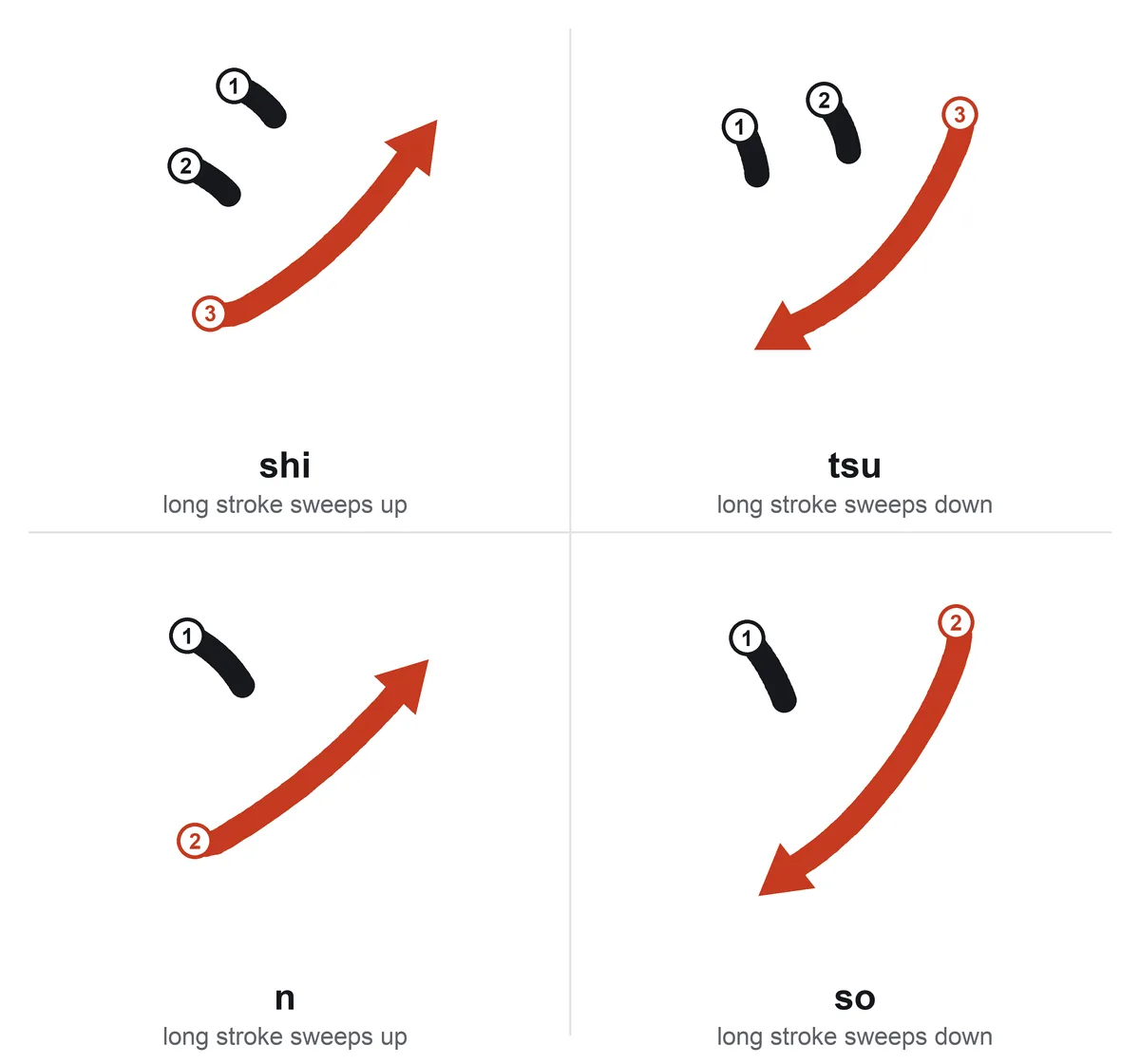
シ and ン finish by sweeping up from the lower left, and their short ticks lie flatter. ツ and ソ finish by sweeping down from the top right, and their ticks stand more upright. In シ the two ticks are stacked on the left; in ツ they sit side by side along the top. Two everyday words let you compare them: シャツ (shatsu, shirt) has シ and ツ, and パソコン (pasokon, computer) has ソ and ン.
The other look-alikes differ by one stroke:
| Pair | What to look for |
|---|---|
| ノ メ no, me | メ is ノ with a short stroke crossing it. |
| ス ヌ su, nu | The second stroke crosses the first in ヌ. In ス it only leaves it. |
| ク タ ku, ta | タ has a short extra stroke inside. |
| ク ケ ku, ke | ケ has a flat bar, with a stroke falling from it. |
| ア マ a, ma | The short second stroke falls to the lower left in ア, to the lower right in マ. |
| チ テ chi, te | The top stroke slants down to the left in チ. In テ it is flat. |
| フ ワ ウ fu, wa, u | フ is one stroke. ワ adds a short stroke down the left. ウ adds a tick on top as well. |
| コ ユ ヨ ko, yu, yo | The bottom line runs past the sides in ユ. ヨ has a bar in the middle. |
Some katakana also match kanji you will meet later: ロ and 口 (mouth), ハ and 八 (eight), ニ and 二 (two). The surrounding words tell you which one you are reading.
Practise with words you already know
Katakana has one gift for learners: much of what it spells is already familiar. You sound out the characters, and an English word appears. Try these before you read the answers: ホテル, テレビ, タクシー, ミルク. They are ホテル (hoteru, hotel), テレビ (terebi, TV), タクシー (takushii, taxi) and ミルク (miruku, milk). The sounds shift to fit Japanese, so read slowly and say the word aloud. When a word stops you, the cause is often a look-alike or a missing line, so check those first.
Where Michi comes in
Michi teaches katakana in its third unit, Katakana & loanwords, straight after the two hiragana units. The goal is practical: reading a café menu. The 46 characters and the long-vowel mark come in groups, and you tap each one to hear it played slowly. The words are menu words such as コーヒー and ケーキ, and the reading exercise is a short menu with prices.
The look-alikes get attention. One listening question plays ソ and asks you to choose between ン, ソ and リ, and another plays シ against ツ and ミ. In the writing lesson you trace コ, シ, ツ, ソ and ン over a faded model while Michi checks the number, position and direction of your strokes. The audio is text-to-speech.
Two limits are worth knowing. The unit shows the voiced kana through a sample and real words, not one by one. The foreign-sound combinations have no cards of their own: カフェ appears in this unit, while チェックイン, ファイル and ウォーキング turn up as vocabulary in later units.
The unit is part of the free Starter stage, with both hiragana units, on iPhone, iPad and Android. Michi Premium opens the path from N5 to N1, which is where those later words sit.
Read your first café menu
The whole Starter stage is free, katakana included.