Grüezi
How to Learn Swiss German: A Simple Plan, Online or Free
To learn Swiss German, online or in person, follow a simple plan. Pick the dialect where you live, get your ear used to it first, choose one main way to study, and use what you learn with real people every week. Much of the listening side is free, so you can start today.
This post is for anyone in Switzerland, or moving here, who has decided to learn and wants a plan. If you are still deciding where to start, read High German or Swiss German First? If you want to know how big the job is, read Is Swiss German Hard to Learn?
Step 1: Pick your dialect
Swiss German is a family of dialects, and “I don’t know” shows it: Ich weiss nöd in Zurich, I weiss nid in Bern, I weiss nit in Basel. Learn the one your neighbours and colleagues speak. If you have not settled yet, Zurich German is a sensible start. We compare the main dialects in Zurich vs Bern German.
This choice also decides what you buy. Before you pay for a course, a book or an app, check which dialect it teaches.
Step 2: Get your ear used to it first
Dialect is what you will hear in shops, on the tram and at work, so train your ear before you worry about your own accent.
Swiss radio and TV. They cost nothing to try. Skip the main TV news, which is in Standard German, and look for talk shows, which are in dialect. Short clips with Standard German subtitles make a gentle first step.
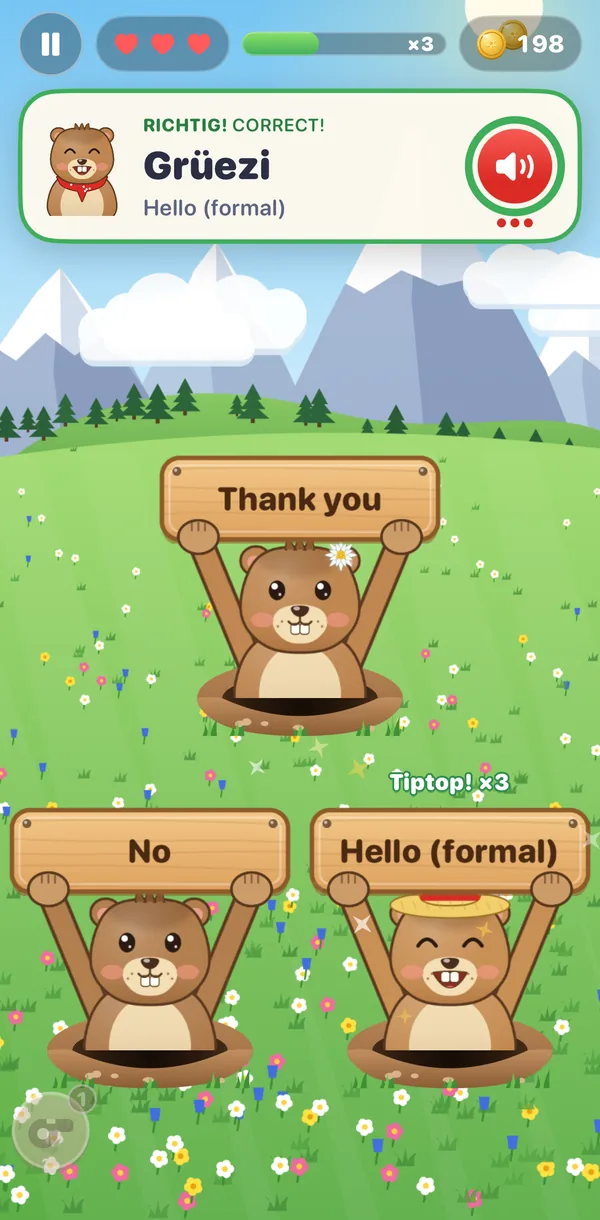
A listening game. Schwiizerli, the game inside Grüezi, plays one word at a time, so you can train your ear in a few minutes on the tram.
Keep each piece short and hear it more than once: first for the topic, then for the words you know. Standard German helps here, because a handful of sound patterns connect many words you already know to their dialect forms.
Step 3: Choose one main way to study
Pick one option and stay with it. Everything else supports it.
| Option | Good for | Check first |
|---|---|---|
| A course | Structure, a teacher and classmates | The entry level, because some courses assume you already have German |
| A private teacher | Correction, and a dialect no local course covers | Which dialect the teacher speaks |
| A university language centre | People who study or work at a university | Whether you have access, and the fees |
| A book | A reference to keep beside audio | Which dialect it is based on |
| An app | Daily habits and vocabulary | What it does not do: an app is weaker at correcting you |
Be careful with books. They exist, for dialects such as Zurich, Bern and Basel, but they can only take you part of the way. Swiss German is mostly a spoken language with no binding spelling rules, so spellings differ from one book to the next, and print cannot show you how a word sounds. Use a book as a reference beside audio, not as your main resource.
How to learn Swiss German online and for free
You can do the whole listening side online at no cost, with Swiss radio, TV and dialect podcasts. For a structured start, the free part of Grüezi gives you a first unit of lessons, two dialogues and the first five levels of Schwiizerli.
Free does not have to mean online. Free dialect groups exist too, so it is worth asking your library or commune what they offer.
What free rarely gives you is someone who corrects you every week. If your budget stretches to one paid thing, make it that.
A simple weekly routine
One example sentence in our app says Ich üebe jede Tag e Viertelstund Schwiizerdütsch, “I practise Swiss German for a quarter of an hour every day”. That is a good size: small enough to survive a busy week. Here is one way to fill it out:
| When | What |
|---|---|
| Every day, 15 minutes | Hear one short clip, or review your words |
| Twice a week | Work through your main resource: a lesson, a chapter or your class |
| Once a week | Use one new phrase on a real person, at the bakery or with a colleague |
| Once a week | Have a real conversation with a teacher, a group or a patient friend |
| End of the week | Note three things you heard but did not understand, and ask someone |
If a week falls apart, keep the daily listening and drop the rest. For the phrases themselves, start with how to say hello and our list of everyday Swiss German phrases.
How to get Swiss people to keep speaking dialect with you
Learners often report the same thing: you try a few words, and the other person switches to Standard German or English. It is usually meant kindly. A teacher in one of our app’s dialogues does exactly this: Mir chönd gern Hochdütsch rede, “We can happily speak High German”. A few things help.
Say it first, in dialect. Ich lerne Schwiizerdütsch means “I’m learning Swiss German”, and it tells people what you are trying to do.
Offer a deal. In any language you share, ask them to stay in Mundart, the word the Swiss use for their dialect, and to switch only if you look lost. You can answer in Standard German. The Canton of Zurich tells newcomers that using it is no problem, so a conversation in two languages is a fair way to practise.
Ask for words. Was heisst Croissant uf Schwiizerdütsch? works with any word you swap in, and it brings the conversation back to dialect.
Choose your people. One colleague or neighbour who agrees to help is worth more than ten strangers in a hurry. A quiet shop is a better place to try than a queue at eight in the morning.
Where Grüezi comes in
Grüezi is our app for the daily part of this plan, on iPhone, iPad, Mac and Android. It has 95 lessons, 30 dialogues and 1,368 words in a Zurich-based Swiss German. You choose from 20 regions, and notes show the local form of some key words, in writing. The audio stays in one Zurich voice and is made with text-to-speech.
For Step 2, version 4.0 adds Schwiizerli, a listening game. A word plays, marmots pop up holding meanings, you tap the right one, and missed words go to your flashcards. For the real-world part of your week, the app sets one small Alltags-Mission a week, such as greeting a shop assistant with Grüezi.
The first unit, Grüezi! Basics, is free, with five lessons. So are the bakery and train station dialogues, the greetings word list, two situation packs, two pattern cards, three dialect comparisons, one daily challenge a day and the first five levels of Schwiizerli. Premium opens the rest.
It will not correct you the way a teacher does, so use it beside real conversations, not instead of them. For the story behind it, read The Swiss German People Actually Speak.
Train your ear on Swiss German
The first unit, two dialogues, two pattern cards and the first five levels of Schwiizerli are free.