Grüezi
Is Swiss German Hard to Learn, and How Long Does It Take?
Yes, Swiss German is hard to learn, but not for the reason most people expect. The grammar is not the problem: in places it is simpler than Standard German. The hard part is understanding it. There is no standard form, it changes from region to region, it is hardly written, and people often switch language when they hear you are a foreigner. Speaking a little is far easier. As for how long it takes, we found no study that has measured it, so we will not give you a number.
This post is for anyone deciding whether to try, whether your colleagues talk dialect at lunch or your partner’s family does at the table. It splits the question in two, compares Swiss German with German, and says what can honestly be said about time.
Is Swiss German hard to learn? Two jobs, not one
“Learning Swiss German” sounds like one task. It is two, and they differ a lot.
| Understanding | Speaking | |
|---|---|---|
| Who sets the level? | The other person: their dialect, speed and words | You: your dialect, your pace, your sentences |
| Can you avoid it? | Hardly, if dialect is spoken around you | Yes, you can answer in Standard German |
| What makes it hard? | Everything in the next section | Finding people who will keep going in dialect |
Understanding is the job you cannot skip. In the German-speaking part of Switzerland, 83% of working people usually speak Swiss German at work, and 85% of the population use it regularly, according to the Federal Statistical Office. You do not choose who talks to you or where they grew up.
Speaking is a job you can do in small pieces. The Canton of Zurich tells newcomers plainly that they can use Standard German and ask the other person to answer in it. So your ear decides whether you can follow the conversation, while your mouth can catch up slowly.
What makes Swiss German hard
There is no standard form. As the Swiss broadcaster SRF puts it, no standard Swiss German exists, and there are no binding spelling rules. Swiss German has no referee.
There are many dialects. SRF counts four dialect boundaries inside the canton of Aargau alone. Here is one sentence you will want early, from the comparison table in our app:
| Where | “I don’t understand” |
|---|---|
| Zürich | Ich verschtaa nöd |
| Bern | I verschtah nid |
| Basel | I verschdoo nit |
| Valais | Ich verschtaa nit |
| St. Gallen | I verschtaa nöd |
| Appenzell | I vöschtoo ned |
Everyday words can drift much further: an apple core is a Bütschgi in Zürich, a Gröibschi in Bern and a Murmutz in Valais. For how two big dialects compare, see Zurich vs Bern German.
It is hardly written. The Federal Statistical Office describes Swiss German as used mostly orally, with Standard German as the written language. Text messages are the exception: 41% of a corpus of 25,947 Swiss text messages from 2009 and 2010 were in dialect. But with no spelling standard, they are a shaky thing to study from. In a study of WhatsApp messages, the same sound was written gs or x, so gsi (been) also appears as xi. In practice you learn by ear.
Teaching is built around Standard German. The Canton of Zurich’s language page for newcomers points to German courses and gives no advice on dialect. A study of Thai women living in German-speaking Switzerland describes the result: what they learn in class does not always match what they mostly hear. Swiss German courses do exist, and our guide on how to learn Swiss German covers the options.
People switch. Many Swiss move to Standard German or English once they hear an accent. It is meant kindly: speaking Standard German counts as polite when someone present does not speak the dialect. We found no study of how often this happens, so take it as what learners report and not as a statistic. It costs you practice just when you need it.
What makes it easier than you fear
One past tense. Swiss German has no everyday simple past. Everything is told with the perfect, the form with gsi, so you learn one way to talk about the past. Standard Gestern war es schön becomes Geschter isch es schön gsi: yesterday it was beautiful. A past subjunctive survives, but you can leave that for later.
No genitive in everyday speech. Swiss German says “of” instead: De Vater vo de Anna schaffet bi de SBB, Anna’s father works for the SBB. Some dialects, such as rural Bernese, keep a possessive genitive. This is a shortcut, not a free pass: nouns still come with their articles, as in de Vater and d Mueter.
Regular sound patterns. Much of the vocabulary is German run through a few changes. Käse is Chäs, Rechnung is Rächnig. Of the nine patterns in our app, five work as rules and four as tendencies, and this post goes through them all.
You never have to write it. Letters, forms and contracts are in Standard German, and with no official spelling, nobody can mark a text message wrong.
People are glad you tried. In our experience, even a few words of dialect are noticed and welcomed, and nobody expects them to be perfect.
Is Swiss German harder than German?
It depends on where you start.
If you have no German yet, Swiss German is the harder project, even with its lighter grammar. Standard German has one form you can read, look up and study anywhere, and you will need it anyway for anything written. Recent university course listings assume that order: one Swiss university’s course on understanding Swiss German asks for at least B2 German. We go through the choice in High German or Swiss German first?
If you already have Standard German, Swiss German is a smaller project than German was, because the patterns let you reuse what you know. But expect a shock first. Swiss German is largely unintelligible to Standard German speakers without prior exposure, and interviews with Swiss speakers generally get subtitles on German television. If people raised on German need time, so may you. Swiss German vs High German sets out what differs.
If you are an English speaker, your English helps in small ways. Where English has a long i, as in time or wine, Swiss German usually has ii: Ziit, Wii. Where it has ou, as in mouse, Swiss German usually has uu: Muus. English is also the trap: 45% of people in German-speaking Switzerland use it regularly, so a conversation can slide into English at your first pause.
How long does it take to learn Swiss German?
We found no study that measures it. There are guesses online, but none we saw shows where its number comes from, so we are not adding another.
The nearest official reference is about a different language. The US Foreign Service Institute, which trains American diplomats, estimates about 36 weeks of full-time study for English speakers to reach professional working proficiency in German, and says the real time varies with aptitude, language experience and class time. That figure is about Standard German, full-time trainees and professional speaking and reading. It tells you nothing direct about Swiss German.
Three things will decide your own time:
Your Standard German. The more you have, the more of the patterns you can use straight away.
How much dialect you hear. A partner’s family or a dialect-speaking team gives you hours a week of real speech. An English-speaking office gives you almost none.
Your goal. Catching greetings at the shop, following a conversation aimed at you, following colleagues talking among themselves and speaking dialect all day are four different projects.
For a sense of scale, our app’s course has 95 lessons and 1,368 words. That is the size of the content, not a promise of how long it takes anyone.
So, should you try?
If dialect fills your workplace or your partner’s family, yes, and start with your ear. If your days run in English or Standard German, you can live well without speaking it, though following a little is still worth having. Either way, you choose the size of the job.
Where Grüezi comes in
Because the ear is the hard part, the newest thing in Grüezi is a listening game. In Schwiizerli, new in version 4.0, a Swiss German word plays, marmots pop up holding meanings, and you tap the right one. There are 60 levels in six worlds, and the words you miss go to your flashcards.
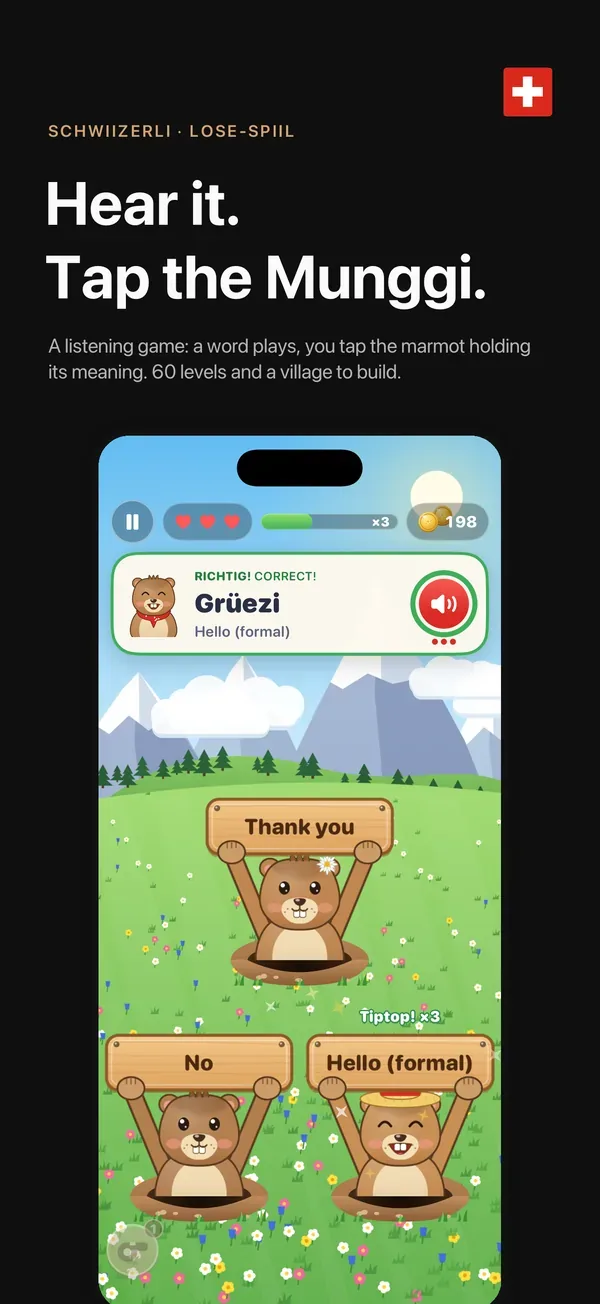
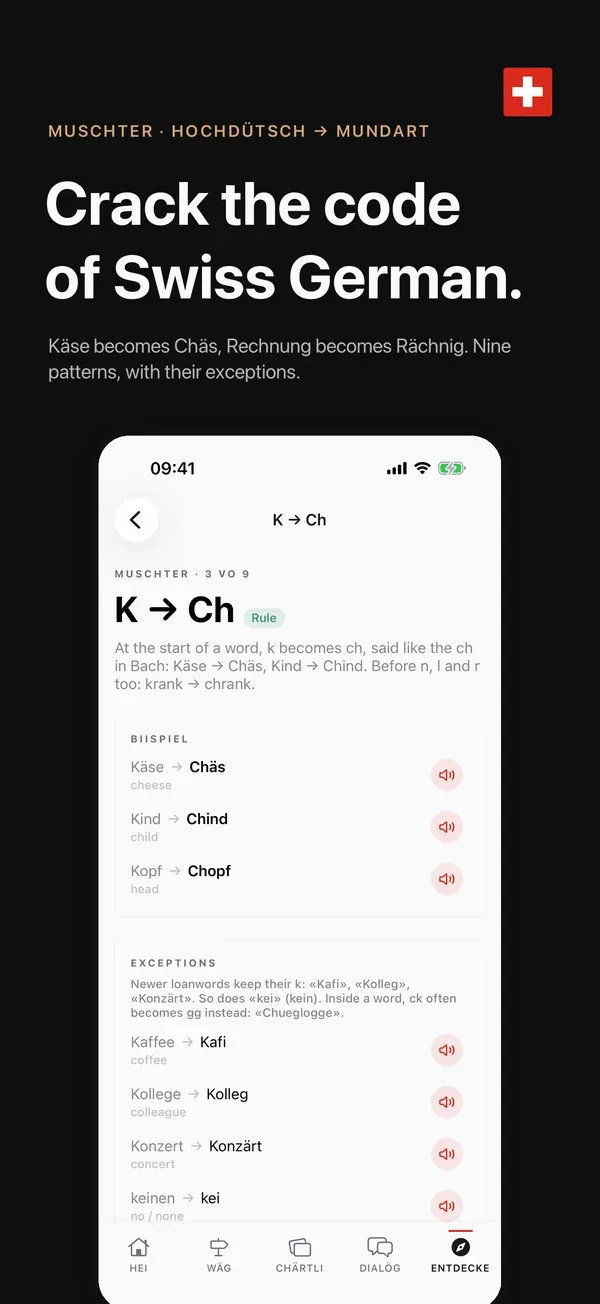
Behind the game is a course of 95 lessons, 1,368 words and 30 dialogues, with the Standard German beside every word, plus nine pattern cards. If you already speak German, a placement check of up to 12 questions finds where to start.
Two limits, plainly. The lessons are built on Zürich German. Choose another of the 20 regions and the app shows the local form of some key words, and 22 everyday phrases can be compared across eight dialects, but the audio stays in Zürich dialect. And that audio, 1,123 clips, is made with a Swiss German speech synthesizer. It helps your ear with the words, but it does not replace the people around you.
The first unit, Grüezi! Basics, is free, along with the greetings word list, two dialogues, two situation packs, two patterns, the first five Schwiizerli levels and one daily challenge a day. The rest is part of Premium. Grüezi is on iPhone, iPad, Mac and Android.
Train your ear for Swiss German
The first unit, two dialogues and the first five Schwiizerli levels are free.