Bürgertest
Swiss Citizenship Test Questions: Examples With Answers
Swiss citizenship test questions cover six areas: geography, history, politics and society, then your canton and your commune. Most are short and factual, such as how many seats a chamber of parliament has or when women won the vote. Depending on the canton, you tick multiple-choice answers or an official asks you face to face. There is no national question list. Each canton decides how to test you, a few publish their questions, and many publish nothing.
The examples below come from Bürgertest, our app for this test. We wrote them from primary sources, so they show the style and level of the Swiss naturalisation test (or “naturalization test”), not the wording of any official paper, and we rechecked every answer for this post. Rules change, and only your commune and canton are binding. For formats, read how the test differs by canton. This post is about the questions.
What Swiss citizenship test questions look like
Federal rules ask for basic knowledge of Switzerland’s geography, history, politics and society. A canton may test this, and if it does, it must make sure you can prepare with suitable materials or courses. Those subjects can come round at three levels: Switzerland, the canton and the commune. Few questions need deep reasoning. They need you to be exact, and that is where they catch people.
Geography: read every word
Geography questions often turn on a single word, so slow down.
| Question | Answer | Why it catches people |
|---|---|---|
| Which lake lying wholly on Swiss territory has the largest surface area? | Lake Neuchâtel | Lake Geneva is far bigger, but it is shared with France. “Wholly” decides the answer. |
| Which mountain is the highest summit in Switzerland? | The Dufourspitze | The Matterhorn is the famous one. The Dufourspitze stands at 4,634 m. |
| How many countries does Switzerland border? | 5 | Germany, France, Italy, Austria, and Liechtenstein, which is easy to forget. |
History: dates that sound interchangeable
The trap here is mixing up two dates that feel like the same event.
| Question | Answer | Why it catches people |
|---|---|---|
| In which year did Switzerland become a modern federal state? | 1848 | 1291 is the Federal Charter, a different milestone. |
| Since when have women had the right to vote at federal level? | 1971 | Only men could vote on it, on 7 February 1971. |
| In which canton did women obtain the right to vote in cantonal matters only in 1990? | Appenzell Innerrhoden | A separate fact from 1971. The Federal Supreme Court settled it after the Landsgemeinde said no. |
| When did Switzerland join the Schengen Area? | 2008 | One option is “It has not joined”. Switzerland is outside the EU, yet inside Schengen. |
Politics: where instinct misleads you
These answers come straight from the Federal Constitution, and instincts from elsewhere can work against you.
| Question | Answer | Why it catches people |
|---|---|---|
| How many valid signatures does a federal popular initiative need? | 100,000 | Easy to swap with the referendum figure. You get 18 months. |
| How many signatures does an optional referendum against a federal act need? | 50,000 | Half the signatures, but only 100 days. |
| A constitutional amendment wins the majority of the people but not the majority of the cantons. What happens? | It is rejected | Both majorities are required. |
| How many cantons have only one seat in the Council of States? | 6 | Obwalden, Nidwalden, both Basels and both Appenzells. The rest have two. |
| Can the Federal Supreme Court strike down a federal act passed by parliament? | No, it must apply federal acts | Switzerland has no constitutional review of federal acts. The check is the referendum. |
Society: everyday life counts too
These are about how daily life works, and you can live here for years without needing the answer.
| Question | Answer | Why it catches people |
|---|---|---|
| Who pays the premiums for basic health insurance in Switzerland? | Each insured person themselves | Not your employer. |
| What are today’s AHV contributions used for? | They directly finance the pensions currently being paid | It is not a savings pot. The AHV is pay-as-you-go. |
| Who may address a petition to an authority in Switzerland? | Anyone, even without voting rights | The Constitution gives this right to every person, not only citizens. |
Your canton: the same question, a different answer
This is where a national list runs out: the answers change at the border.
| Question | Answer |
|---|---|
| How many members does the Zurich cantonal government have? | 7 |
| How many members does the cantonal government of Aargau have? | 5 |
| After how many years of legal residence in Switzerland may foreign nationals vote at the municipal level in Geneva? | After 8 years |
| On what conditions may a foreign national vote at communal level in the canton of Vaud? | After ten years in Switzerland and three in the canton |
| Where is the Salève, the mountain overlooking Geneva? | In France |
The federal answer is no guide: the Federal Council has seven members, Aargau’s government five. And Geneva’s landmark mountain stands in Haute-Savoie.
Your commune: questions no list can answer
Local questions often come up in conversation. Aargau, for one, says it examines knowledge of your commune at the naturalisation interview. These prompts come from our interview practice, not an official list.
| Question | How to prepare |
|---|---|
| Who sits on the municipal council of your municipality? | Check the authorities page on your commune’s website. |
| Which municipalities share a border with the place you live? | Two to four names is enough. A map sticks better than a list. |
| Where do you find out what is being decided where you live? | Name a source you really use, such as the municipal bulletin or the local paper. |
Two more things that make them harder
The language. We show the examples in English, but the test is held in the canton’s language. The double-majority question above reads Eine Verfassungsänderung erhält das Volksmehr, aber nicht das Ständemehr. Was geschieht? in German. If you know the fact but not the word Ständemehr, you still lose the point.
Answers age. “Which municipality moved from the canton of Bern to the canton of Jura on 1 January 2026?” Moutier. Communes also merge and populations grow, so check the date on anything you study from.
Swiss citizenship test practice: where the official lists are
Start with your canton. Here is what we found, and your commune can confirm what applies to you.
Full question lists. Zurich publishes all 350 questions, a study brochure and an online practice test. Aargau has a practice test and its full question list. Neuchâtel publishes every question it can ask, with or without answers. Vaud runs the A-Vaud-Test platform, where you can try all 160 questions or sit 48 in an hour, as in the exam.
Partial material. Valais publishes a questionnaire with separate answers, but describes it as a selection, not a complete list. Bern has no catalogue, but it points to past test papers with solutions. Lucerne has 100 questions and answers, headed for facilitated naturalisation and dated April 2021, so ask whether they apply to you. Geneva offers a tutorial and a quiz. St. Gallen’s test provider has sample questions. Appenzell Innerrhoden publishes a guide rather than questions.
No question list. On 30 October we found no question list on the cantonal pages of Basel-Stadt, Glarus, Graubünden, Obwalden or Schwyz, and in August none for Ticino. Other cantons say little about their tests. If someone sells you an “official” list for one of those cantons, ask where it came from. Our German guide has a table with a link for every canton where German is an official language. A canton that tests you must make it possible to prepare, so ask what to use. For the federal system, try the Federal Chancellery’s The Swiss Confederation: a brief guide.
Where Bürgertest comes in
We built Bürgertest for people whose canton publishes little, and for anyone who wants an explanation as well as a tick. On the App Store it is listed as Bürgertest – Einbürgerungstest. You choose your canton, then study the federal questions plus a pack for that canton. The questions are our own, not copied from cantonal catalogues, and each one shows its source and explains the answer.
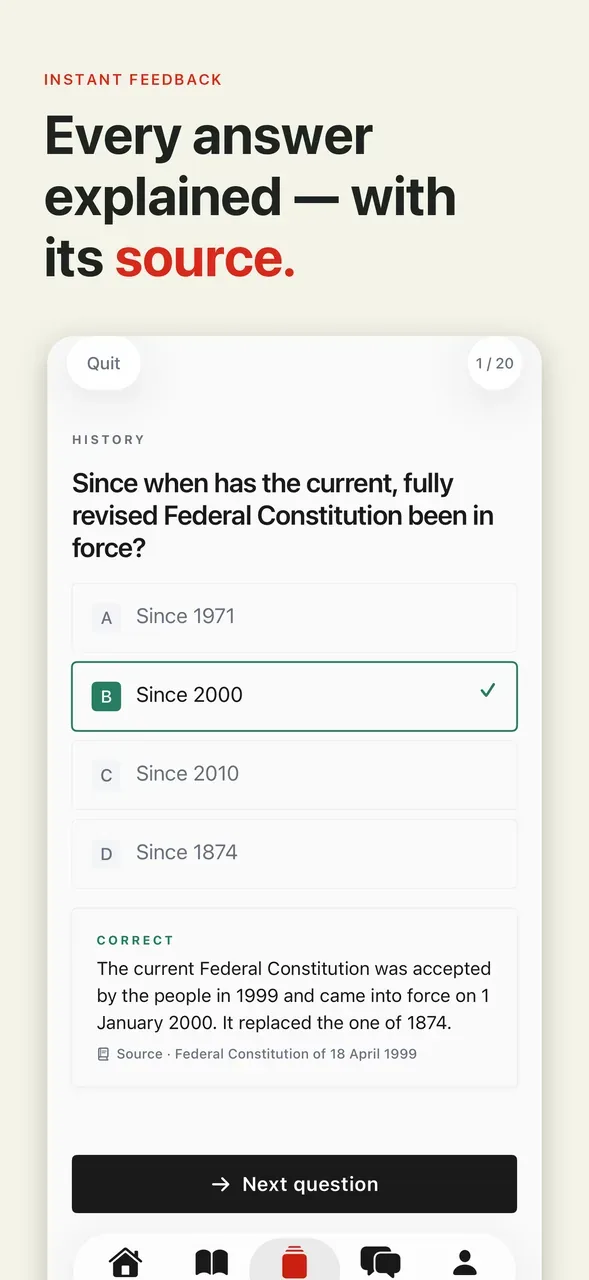
The timed mock test follows your canton’s published format, and says so when your canton publishes none. Interview prompts and lessons can be read aloud by a text-to-speech voice in your exam language. Language practice is in the style of the fide test, not the official test. You can study in English, German, French, Italian, Portuguese, Spanish or Thai.
Free: the facts for all 26 cantons, the step-by-step application guide, every interview question with guidance on the first three, three lessons, one mock test, 20 practice questions a day and one fide-style scenario. The rest unlocks with a subscription or a one-time purchase. Bürgertest is on iPhone and iPad.
Bürgertest is a private learning app by KK Studio, with no connection to the Confederation, the cantons or the communes. It cannot promise you a pass, and its information comes without guarantee. Only the official information from your commune and canton is binding, so use the app to learn and use them to check.
Practise for your canton’s test
Free: facts for all 26 cantons, the application guide, every interview question, three lessons, one mock test and 20 practice questions a day.